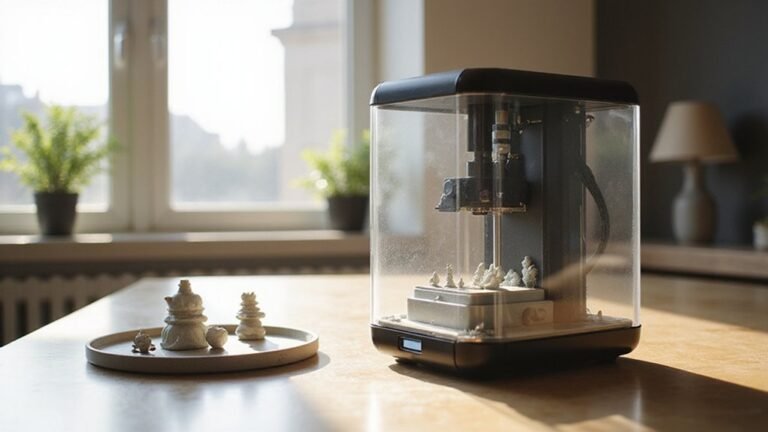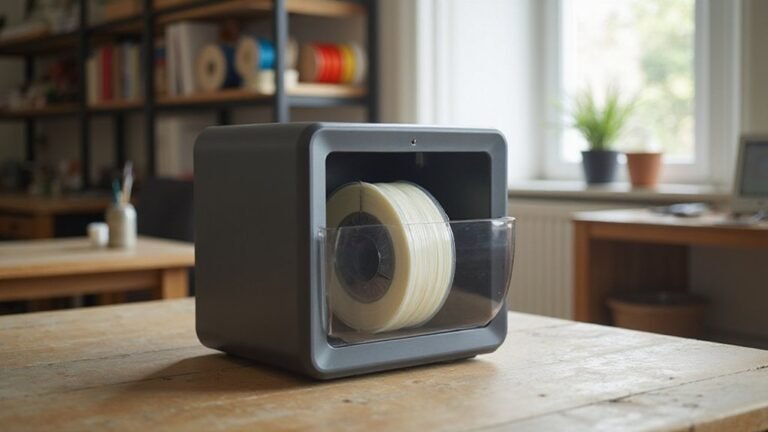
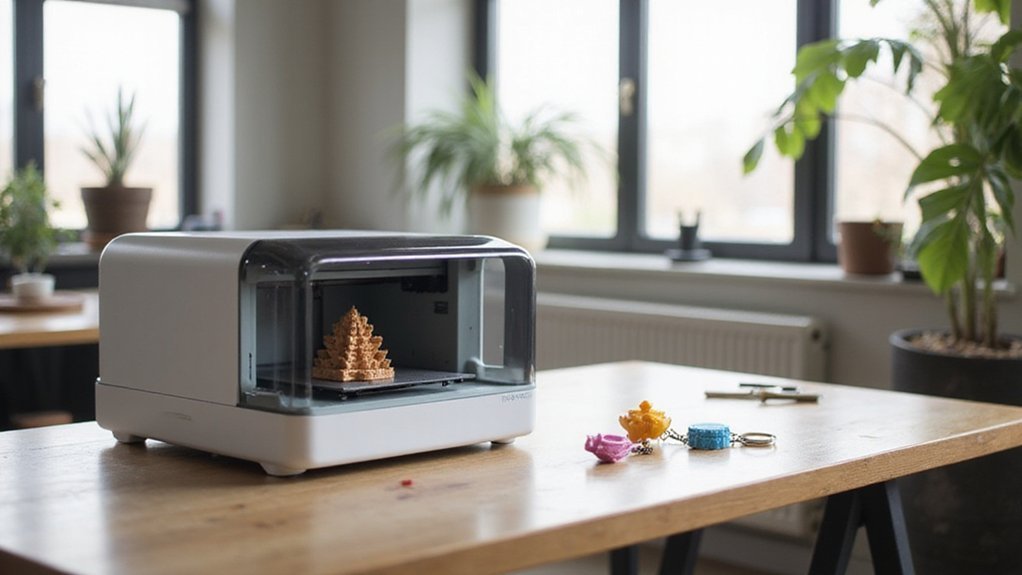
Wondering what you can create with a 3D printer? From small household tools to intricate art pieces, this technology opens up a world of possibilities.
With it, you can produce practical items, personalized gifts, or even educational models. Keep reading to discover how versatile a 3D printer truly is and how you can turn your ideas into reality.
Discover Household Items You Can 3D Print at Home
You can create a variety of household items at home using a 3D printer, especially for organization purposes. Printable utensil holders keep spatulas, spoons, and whisks neatly grouped on counters or inside drawers. Drawer dividers help segregate cutlery and small gadgets, making your space more orderly. Small storage bins are perfect for batteries, loose change, or small accessories, while extendable cup holders fit patio chairs, adding convenience outdoors. In bathrooms, soap holders and sink-side organizers reduce clutter, promote quicker drying of soaps, and improve water drainage. Wall hooks are versatile for hanging towels and toiletry bags, and toilet paper roll holders keep essentials within easy reach. Over 20 practical 3D printable kitchen tools are available from sites like Printables or MakerWorld, tested in filaments such as PLA and PETG, offering a wide range of customizable options. Additionally, 3D printing materials enable users to craft durable household items suited for daily use. Understanding how to use 3D printing effectively can help you create solutions tailored exactly to your needs. When selecting printing techniques, considering the printing precision can significantly impact the quality and durability of your household items. With a 3D printer, you can turn clutter into functional, customized household essentials with ease.
Creative Ways to Use 3D Printing for Gifts and Home Decor
3D printing offers a vast array of creative options for making personalized gifts and distinctive home decor pieces. You can create custom ornaments like lithophanes, which turn family photos into illuminated keepsakes, adding warmth and nostalgia to holiday decorations. Designing unique jewelry such as pendants, rings, or charms allows you to craft stylish accessories tailored precisely to your taste or special occasions. Small personalized items like name keychains, desk signs, or initial bookmarks add a meaningful touch to everyday objects. For home decor, you can make textured vases, customized planters, or wall art that reflects your style. Additionally, you can design custom lamps or nightlights that incorporate personal photos or themes, transforming ordinary objects into functional art pieces. To ensure the best results, understanding drying filament without a dryer methods can help maintain filament quality and longevity for your projects. Exploring different 3D printing techniques can further enhance your creative possibilities and project outcomes. Recognizing that filament can go bad if not stored properly encourages makers to take better care of their materials, leading to more successful prints. These creative projects bring a personal flair and unique aesthetic to your living space and gifts.
Practical 3D-Printed Tools and Replacement Parts for Everyday Use
Having the right practical tools and replacement parts readily available can significantly improve your 3D printer maintenance routine. Essential printable tools include build-plate removal tools like sturdy metal scrapers, precision model cutters, and fine-tipped tweezers for cleanup. For repairs, keep organized sets of metric Allen screwdrivers, a multimeter, and zip ties to enable quick fixes. Custom filament guides can be 3D printed to enhance filament feeding consistency, while ergonomic handle designs can reduce fatigue during routine tasks. Printable replacement parts, such as clips, hooks, cable guides, or heatbreaks, can be produced on demand, saving both time and money. Using durable filament materials like PETG or certain composite filaments for these parts ensures they withstand regular use, increasing your printer’s filament strength and making maintenance smoother. Additionally, integrating laser engraving into your workflow allows for customized labels and part identification, improving organization and efficiency. To better understand material properties, selecting the right filament type for these components can impact their durability and overall performance.
How to Design and Print Toys, Games, and Hobby Models
Designing and printing toys, games, and hobby models offers limitless creative possibilities directly from your desk. With custom toy design, you can craft unique action figures, miniature playsets, or replacement game pieces tailored precisely to your preferences. Hobby model printing allows you to create detailed objects like puzzles, brain teasers, dice towers, or magnetic tokens, all of which can enhance your tabletop gaming experience. Beginners should start with user-friendly software like Tinkercad, which provides intuitive tools for simple designs. For more complex parts, advanced users often prefer Fusion 360 for its powerful features. High-quality STL files are readily available on platforms such as Printables.com and MyMiniFactory, offering inspiration or a starting point for customization. To achieve the best results, choose materials like PLA for detailed decorative models or PETG for more durable toys. When selecting a 3D printer type, consider its capabilities and how well it aligns with your hobby projects. To finish your prints, consider sanding rough edges, painting for added detail, or applying clear coats to improve appearance and longevity. Additionally, understanding the print resolution and how it affects fine detail can significantly improve your final model quality. A proper understanding of printing costs can also help you optimize your budget while expanding your creative projects.
Using 3D Printing for Education and Prototyping Projects
Using 3D printing for education transforms abstract ideas into tangible objects, making complex concepts easier for you to understand. It fosters educational innovation by allowing students to create physical models of topics such as math, science, geography, and history. Examples include geometric solids, skeleton replicas, terrain maps, and artifacts. These models help clarify difficult concepts and engage multiple senses, enhancing learning.
In prototyping projects, students gain hands-on experience with modeling, slicing, and printing. This process links digital design to real-world applications, encouraging you to test ideas iteratively. Redesigning and problem-solving become integral parts of the learning experience, developing your critical thinking and creativity. 3D printing also improves accessibility by enabling the creation of customized teaching aids, tactile graphs, and adaptive devices. These tools support inclusive learning environments, ensuring all students can participate effectively.
Through active participation and collaboration, you develop strong communication skills and resilience. Completing 3D printing projects empowers you to innovate practically, preparing you for future challenges in various fields.
Exploring Large-Scale and Advanced 3D Printing Projects
Large-scale 3D printers can produce objects over several meters in size. These printers are capable of creating substantial, functional structures that traditional manufacturing methods struggle with due to size constraints. For example, you might print an entire boat hull or a large industrial component in a single piece. This capability significantly reduces assembly time since fewer joints or fasteners are necessary, leading to stronger and more seamless parts. The large build volume also allows for rapid prototyping of big-scale items, helping you iterate designs more efficiently. Heat transfer vinyl can be used to add decorative or functional elements to large wooden projects created with 3D printing.
In industrial settings, large-format 3D printing streamlines workflow by producing durable, oversized parts like transportation structures—such as aircraft components or vehicle bodies—often lighter due to optimized material distribution. This process supports weight savings and integrates complex geometries that would otherwise require multiple manufacturing steps. In art and entertainment, you can craft full-size sculptures or immersive installations that would challenge traditional sculpting or construction methods, opening up new creative possibilities.
These projects leverage the strengths of large-scale 3D printing—size, speed, and versatility—making them an essential tool for pushing the boundaries of design, manufacturing, and creative expression.
How to Get Started: Tips for Choosing Your 3D Printing Projects
When starting your 3D printing projects, choose simple, beginner-friendly models with flat bases, straight walls, and minimal overhangs. These features reduce the likelihood of print failures and make troubleshooting easier. Avoid designs with complex internal structures or holes initially, as they can be challenging for new printers to handle accurately. Layer height affects print resolution and speed — selecting appropriate layer heights can significantly impact your first successful prints. Understanding your 3D printer’s capabilities helps you make informed choices about project complexity and achievable results. Additionally, learning about material properties enables you to select the best filament for your specific project needs.
Opt for small projects that can be completed quickly and fit within your printer’s build volume. Download ready-to-print STL files from reputable sources to save time and prevent file issues. Selecting the right material is crucial—stick with widely used filaments like PLA, which are easy to print, have less warping, and don’t demand high temperatures.
Before starting, ensure your printer is well-calibrated. Proper bed leveling and consistent extrusion are key for successful prints. Use your slicer software to orient your model properly, adjust support settings, and set layer height to balance quality with print time. Beginning with basic calibration tests will help you understand bed adhesion, layer consistency, and material behavior, laying a solid foundation for more complex projects later on.