If you want your 3D prints to come out smoother, more reliable, and less prone to jams, choosing the right PTFE tube is a game-changer. With options like 2.5mm inner diameter tubes or longer 5-meter rolls, each designed to fit popular printers like Ender 3 or Bambu Lab, you’ll notice clearer filament paths and reduced friction—especially useful when printing flexible materials. But with so many choices, how do you find the best fit? Stick around; the top seven options will help you upgrade your setup effortlessly.
Sovol PTFE Tube 2.5mm ID, 4mm OD, 5m with Couplers
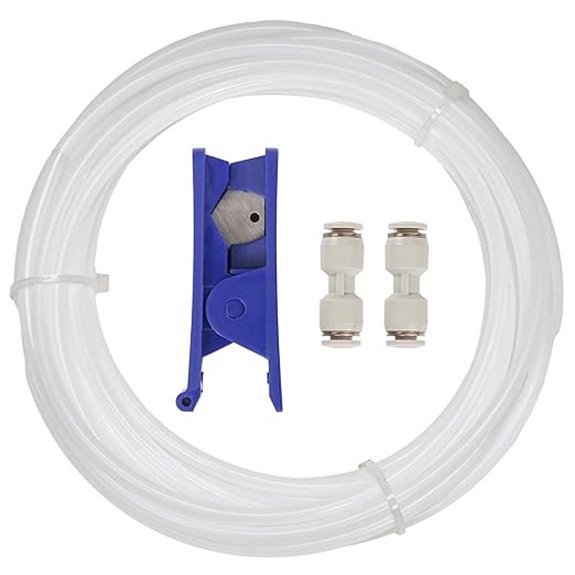
If you’re serious about smooth, reliable filament feeding, especially when printing with flexible materials like TPU or TPE, the Sovol PTFE Tube 2.5mm ID, 4mm OD, 5m with Couplers is a great choice. Made from high-quality PTFE, it offers durability and a slick finish that minimizes friction. The 2.5mm inner diameter helps keep flexible filaments flowing smoothly, reducing jams. Plus, the 5-meter length gives plenty of room to work with, and the included couplers make extending or replacing sections simple. Whether on Bambu Lab, Prusa, or Creality printers, this tubing helps keep your prints consistent and hassle-free!
PTFE Tube Kit for Bambu Lab, Creality, Prusa
https://m.media-amazon.com/images/I/71fgRf72z3L._AC_SX679_.jpg
Looking for a PTFE tube kit that fits multiple 3D printers like Bambu Lab, Creality, and Prusa? You’ve found it. This kit offers a 2.5mm inner diameter, 4mm outer diameter, and a generous 5-meter length—perfect for customizing your setup. The high-quality PTFE material handles high temperatures and keeps your filament flowing smoothly, even on flexible filaments like TPU. Plus, the included couplers make connecting multiple tubes easy, and the touch fastener strips help organize your workspace. Reliable, durable, and compatible with a wide range of printers, this kit is a smart upgrade for consistent, high-quality prints.
Ultra-Clear 1.75mm Filament Tube with Cutter (5M)
https://m.media-amazon.com/images/I/51DLdMgAZmL._SX522_.jpg
The Ultra-Clear 1.75mm Filament Tube with Cutter is a perfect choice if you want to keep an eye on your filament flow without stopping your print. Its transparent design means you can easily see if your filament is running smoothly or if you need to replace it, saving time and frustration. Made of high-quality PTFE, this tube is durable and resistant to high temperatures up to 220°C. The 5-meter length lets you cut exactly what you need and reduces waste. With a smooth interior, low friction helps support precise, high-speed printing, making it a great upgrade for your 3D printer setup.
PTFE Tube 2.5mm ID×4mm OD for 3D Printers
https://m.media-amazon.com/images/I/519eBe8YwBL._SX522_.jpg
This PTFE tube with a 2.5mm inner diameter and 4mm outer diameter is perfect if you want smooth, efficient filament flow in your 3D printer. Made from high-quality PTFE, it resists high temperatures, guarantees durability, and keeps corrosion at bay. With its milky white, low-friction surface, it minimizes filament drag—think of it as a slick highway for your filament to glide through. You’ll appreciate the 5-meter length, giving you plenty of wiggle room for multiple projects. Plus, it comes with a handy cutter, making custom-length adjustments a breeze. Compatible with popular models like the Ender 3 V3 and Bambu Lab X1 series, this tube supports consistent, high-quality prints every time.
PTFE Bowden Tube for 3D Printers, 5m
https://m.media-amazon.com/images/I/61XaNFOLN3L._AC_SX679_.jpg
If you want smooth filament flow and reliable performance, a 5-meter PTFE Bowden tube might just be your new best friend. Imagine having enough tube length to customize your setup or keep spares handy. Made from corrosion-resistant PTFE, it offers a low-friction surface to help filaments glide effortlessly – perfect for flexible filaments like TPU or TPE, and even PLA. Its heat resistance up to 260°C means you can print longer without worry. Plus, it comes with a handy cutter to make precise cuts, ensuring a snug fit. Whether you’re upgrading or building, this universal fit tube is a neat, dependable choice for your 3D printer.
PTFE Teflon Tubing 5ft for 3D Printer
https://m.media-amazon.com/images/I/51HYlzgaZML._AC_SX679_.jpg
Looking for reliable tubing that keeps your 3D printer running smoothly? The PTFE Teflon Tubing 5ft is a great choice. With a 2mm inner diameter and 4mm outer diameter, it fits most 1.75mm filament Bowden setups. Made of translucent Polytetrafluoroethylene, it resists chemicals, high temperatures, and stickiness, which means smoother filament feeding and less clogging. And with a temperature range from -454°F to 500°F, you’re covered for most printing needs. Plus, it meets FDA standards and UL flame ratings, making it safe for multiple applications. Just measure, cut, and slide it into your printer—easy!
Creality Teflon Bowden Tube for 3D Printers
https://m.media-amazon.com/images/I/51VVt7lRdvL._SX522_.jpg
Need a reliable tube that keeps your filament flowing smoothly without fuss? The Creality Teflon Bowden Tube is your go-to for consistent, trouble-free prints. Made from high-quality PTFE, it supports 1.75mm filament and fits popular printers like Ender 3 V3, K2 Pro, and K1 series. This 2-meter tube resists heat up to 260°C and stays anti-aging over time—no warping or deformation. Its precise dimensions guarantee reliable filament delivery, compatible with PLA, ABS, PETG, TPU, and more. Easy to install, durable, and trusted by many, it helps you achieve better results without the headaches.
Factors to Consider When Choosing a PTFE Tube for 3D Printer
When choosing a PTFE tube, you’ll want to make sure it’s compatible with your printer’s model, so measurements matter—think about the inside diameter and length. Keep in mind that high temperature resistance is key if you’re printing with materials like ABS or PETG, which generate more heat. And don’t overlook flexibility and durability—these features make installation easier and help the tube last longer, saving you headaches down the road.
Compatibility With Printer
Choosing the right PTFE tube for your 3D printer isn’t just a matter of grabbing the biggest or cheapest one. You need to evaluate compatibility with your printer’s specific setup. First, match the inner diameter (ID) to your filament size—usually 2mm or 2.5mm—for smooth, jam-free feeding. Check that the outer diameter (OD) fits your cable chain or tube holders to avoid any awkward fitting issues. The length matters too—whether you need a standard 5-meter roll or a custom size to suit your setup. Also, confirm if the tube’s material works with your extruder type—be it Bowden or direct drive. Ensuring these factors line up keeps everything running smoothly and helps you avoid frustrating setbacks.
Temperature Resistance Levels
Paying attention to the temperature resistance of your PTFE tube is key to keeping your 3D printer running smoothly at different extrusion temperatures. These tubes usually handle a range from -454°F up to 500°F, but always check the maximum rating before bed. Some tubes are rated for around 220°C (428°F), great for common filaments, while others can withstand up to 260°C (500°F). When selecting, remember that higher resistance prevents deformation, filament jams, and uneven flow. High-quality PTFE tubes often meet safety standards like UL-224 VW-1, ensuring safe high-temperature use. So, match your filament’s needs with the tube’s heat tolerance—it’s a simple step that makes a huge difference in print quality and longevity.
Material Durability Features
Material durability is an essential factor that can make or break your 3D printing experience with PTFE tubes. You want something that can handle the heat and chemicals of your favorite filaments without cracking or degrading. High-quality PTFE tubing resists chemicals and environmental wear, meaning it won’t break down or leach harmful substances into your print. It maintains its structure and flexibility even after prolonged exposure to temperatures up to 260°C or higher—so those long, intricate prints won’t cause trouble.
Look for tubes with a wall thickness of 1.5mm to 2mm; these strike a perfect balance between strength and flexibility. And because of its smooth interior surface, your filament will glide easily, reducing wear and extending your tube’s lifespan.
Flexibility and Bending
When it comes to keeping filament feeding smoothly through your 3D printer, flexibility of the PTFE tube can make all the difference. A flexible tube bends easily without kinking or blocking filament flow, reducing jams and improving overall print quality. Thinner wall tubes tend to be more flexible, but watch out—this can sometimes mean less strength and durability. To prevent cracking or internal damage, always aim for gentle, gradual bends rather than sharp angles. Flexibility helps you customize complex layouts and reduces stress on your filament feeding system. If you choose stiffer tubes, verify they’re well supported and routed carefully to avoid strain. Flexibility isn’t just a convenience – it’s key to smoother, more reliable printing!
Length and Customization
Choosing the right length for your PTFE tubing isn’t just about cutting and fitting—it’s about creating a smooth, reliable filament pathway that matches your specific 3D printer setup. Longer tubes, like a 5-meter spool, give you flexibility for different configurations or future upgrades, and they provide extra material for custom needs. When customizing, cutting the tube to your precise length guarantees you avoid unnecessary slack or tight bends that could cause issues. Using included cutters helps achieve a clean, snug fit, which is key to preventing filament feed problems. Keep in mind, an ideal tube length balances ease of installation with a smooth filament path, reducing the chance of jams and malfunctions. Proper customization makes your print quality more consistent and your setup more adaptable.
Friction and Flow Rate
Ever wonder why some PTFE tubes keep your filament flowing smoothly while others cause frustrating jams? It all comes down to friction and flow rate. A low-friction PTFE tube, with a coefficient less than 0.1, lets filament glide effortlessly, allowing for high-speed printing without resistance buildup. Smoother internal surfaces and consistent wall thicknesses help maintain a steady flow, reducing dragging that can mess with your print quality. When friction is too high, filament grinding or slipping occurs, leading to uneven extrusion and potential failures—no one wants that. Look for tubes rated for high temperature and designed with low friction to keep filament moving smoothly, regardless of the material. Remember, a quality PTFE tube makes all the difference in your printing success!