Many believe the best 3D printers turn out stunning models effortlessly, but the truth is, choosing the right one depends on your needs. Whether you’re after safety features for kids, multi-color capabilities, or high-detail resin printing, there’s no one-size-fits-all. From the beginner-friendly AOSEED for young creators to the precision of the Photon Mono 4, each offers unique benefits. Want to get the perfect model every time? Keep these top picks in mind before making your decision.
| AOSEED 3D Printer for Kids with 8 Models & Filaments |  | Best for Kids and Education | Speed: Up to 400mm/s | Build Volume: Not specified (compact size) | Leveling/Calibration: No manual leveling (leveling-free) | VIEW LATEST PRICE | Read Our Analysis |
| FLASHFORGE Adventurer 3D Printer with Auto Leveling |  | Fastest Professional-Grade | Speed: Up to 600mm/s | Build Volume: 220 x 220 x 220mm | Leveling/Calibration: Automated bed leveling | VIEW LATEST PRICE | Read Our Analysis |
| FLASHFORGE AD5X Multi-Color 3D Printer (600mm/s) |  | Versatile Multi-Color | Speed: Up to 600mm/s | Build Volume: 220 x 220 x 220mm | Leveling/Calibration: Automatic bed leveling | VIEW LATEST PRICE | Read Our Analysis |
| Bambu Lab A1 Mini 3D Printer & LED Lamp Kit |  | Beginner-Friendly Innovation | Speed: High-speed, unspecified max (implied fast) | Build Volume: 220 x 220 x 220mm | Leveling/Calibration: Automatic calibration | VIEW LATEST PRICE | Read Our Analysis |
| ANYCUBIC Photon Mono 4 Resin 3D Printer |  | High-Detail Resin | Speed: Up to 70mm/h (resin printing speed) | Build Volume: 153.4 x 87 x 165mm | Leveling/Calibration: 4-point leveling system | VIEW LATEST PRICE | Read Our Analysis |
More Details on Our Top Picks
AOSEED 3D Printer for Kids with 8 Models & Filaments
If you’re looking to introduce kids to the exciting world of 3D printing, the AOSEED 3D Printer is a fantastic choice—especially for home and educational use. It arrives fully assembled, so no confusing setup, just turn it on and start creating. With a maximum speed of 400mm per second and precise details up to 0.05mm, it’s fast and accurate enough for small projects. Its safety features like an enclosure and pinch resistance mean kids can learn and have fun safely. Plus, it comes with an all-in-one kit, including 8 PLA filament rolls, tools, and fun stickers to personalize prints.
- Speed:Up to 400mm/s
- Build Volume:Not specified (compact size)
- Leveling/Calibration:No manual leveling (leveling-free)
- Material Compatibility:PLA filament
- Control/Monitoring:App control, Wi-Fi, cameras
- Dual/Multiple Colors:Not supported
- Additional Feature:Voice and image prompts
- Additional Feature:Real-time camera monitoring
- Additional Feature:All-in-one starter kit
FLASHFORGE Adventurer 3D Printer with Auto Leveling
The FlashForge Adventurer 3D Printer with Auto Leveling is the fastest professional-grade option perfect for hobbyists and small businesses alike. Its fully automatic bed leveling makes setup a breeze—you’ll avoid tedious manual calibrations, saving time and effort. The printer boasts a 220x220x220mm build volume, a 280°C direct extruder, and a detachable nozzle, which means versatile filament options and easy maintenance. With ultra-fast speeds reaching 600mm/s and quick warm-ups, you can produce detailed models rapidly. Features like remote monitoring, dual-fan nozzles, vibration compensation, and a high-flow nozzle guarantee high quality and efficiency every time.
- Speed:Up to 600mm/s
- Build Volume:220 x 220 x 220mm
- Leveling/Calibration:Automated bed leveling
- Material Compatibility:Multiple filaments (not specified, supports versatility)
- Control/Monitoring:Remote via Flash Maker app
- Dual/Multiple Colors:Single color
- Additional Feature:Fully automatic bed leveling
- Additional Feature:High-speed printing (600mm/s)
- Additional Feature:Removable PEI build platform
FLASHFORGE AD5X Multi-Color 3D Printer (600mm/s)
Looking for a versatile multi-color 3D printer that can handle complex, vibrant designs at lightning-fast speeds? The FLASHFORGE AD5X might be just what you need. It supports up to four colors at once, making multi-material projects a breeze. With a blazing speed of 600 millimeters per second and an acceleration of 20,000 mm/sec², you can prototype quickly or produce batches without long delays. Its 220x220x220mm build volume fits a variety of models, from tiny miniatures to larger parts. Features like auto-leveling, automatic filament feeding, and remote control make setup and operation straightforward. Plus, its versatile nozzle sizes and high-temperature extruder reveal creative freedom.
- Speed:Up to 600mm/s
- Build Volume:220 x 220 x 220mm
- Leveling/Calibration:Automatic bed leveling
- Material Compatibility:Multiple filaments (supports various materials)
- Control/Monitoring:Remote monitoring, auto-resume
- Dual/Multiple Colors:Multiple colors possible (multi-color support via extruder system)
- Additional Feature:Multiple filament options
- Additional Feature:Automatic filament feeding
- Additional Feature:Resume printing after power loss
Bambu Lab A1 Mini 3D Printer & LED Lamp Kit
The Bambu Lab A1 Mini 3D Printer & LED Lamp Kit stands out for its beginner-friendly innovation, making it perfect if you’re just starting out with 3D printing. It’s super easy to set up—ready within 20 minutes—and features automatic calibration, so you don’t waste time tweaking settings. Its high-speed, high-precision printing ensures your models turn out sharp and detailed, even on complex designs. Plus, it operates quietly at 48 decibels or less, so you won’t disturb your space. The kit includes ready-to-print lamp models, ideal for creating decorative lights or personalized gifts, adding a creative touch to your projects.
- Speed:High-speed, unspecified max (implied fast)
- Build Volume:220 x 220 x 220mm
- Leveling/Calibration:Automatic calibration
- Material Compatibility:Various filaments (implied, typical of such printers)
- Control/Monitoring:App control, remote management
- Dual/Multiple Colors:Single color (standard for FDM printers)
- Additional Feature:Built-in LED lamp
- Additional Feature:Ecosystem integration
- Additional Feature:Quiet operation (≤48 dB)
ANYCUBIC Photon Mono 4 Resin 3D Printer
If you’re after high-detail resin printing with sharp surface quality, the ANYCUBIC Photon Mono 4 is a top choice. With a bright 7-inch 10K mono LCD screen and an impressive resolution of 9024×5120 pixels, your models will have incredible detail—each pixel measuring just 17×17 μm. Its stable LighTurbo light source supports fast printing speeds of up to 70mm/h, reducing those dreaded long waits. The laser-engraved print platform enhances adhesion, while the 4-point leveling system makes setup a breeze, especially if you’re new. Plus, it can resume printing after power outages, saving you time and resin waste.
- Speed:Up to 70mm/h (resin printing speed)
- Build Volume:153.4 x 87 x 165mm
- Leveling/Calibration:4-point leveling system
- Material Compatibility:Resin (liquid photopolymer)
- Control/Monitoring:Not specified (assumed standard interface)
- Dual/Multiple Colors:Single color (resin printing)
- Additional Feature:10K high-resolution LCD
- Additional Feature:4-point leveling system
- Additional Feature:Fast resin curing (70mm/h)
Factors to Consider When Choosing a 3D Printer for Models
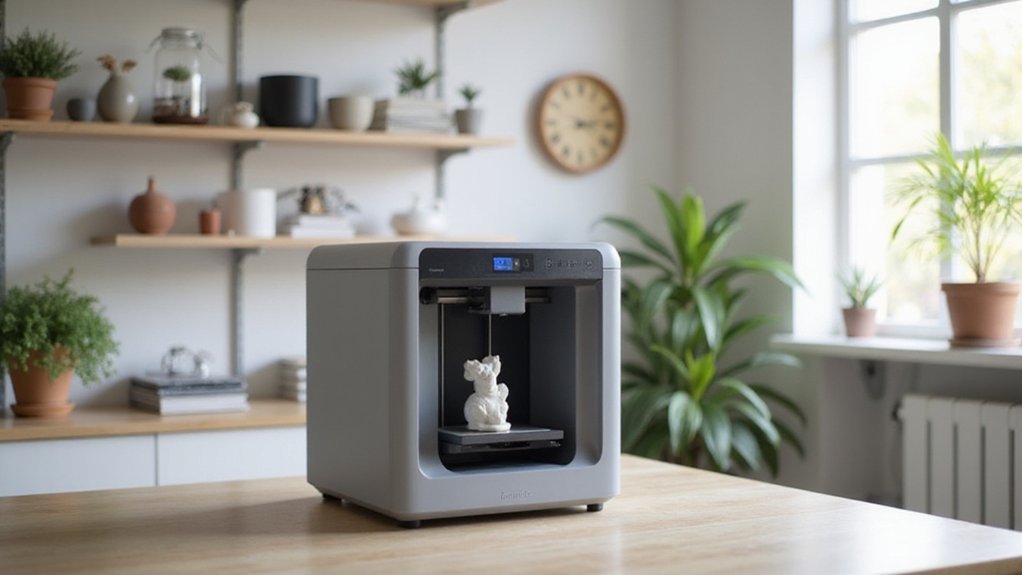
When choosing a 3D printer for models, you want to pay close attention to printing resolution and detail—after all, nobody likes a model that looks blurry or rough. Material compatibility matters too, since some printers work better with specific resins or filaments, impacting the quality and stability of your prints. And don’t forget about speed, safety features, and how easy the machine is to use; these can make or break your overall experience, especially if you’re new or short on time.
Printing Resolution and Detail
Getting the fine details just right can make all the difference in your 3D printed models. Higher resolution leads to smoother surfaces and more intricate features. This is usually controlled by layer height—smaller ones like 0.05mm give you more precision, perfect for tiny details. Resin-based printers generally excel here, offering ultra-high resolutions and finer surface finishes. Some advanced printers even boast display systems with over 9000×5000 pixels for stunning detail. Remember, the nozzle size and the precision of your printer’s movement system also matter. Tighter tolerances mean sharper features. So, if you want models that pop with fine detail, look for printers that boast smaller layer heights and high-resolution capabilities. Good resolution truly elevates your model’s quality!
Material Compatibility Options
Choosing a 3D printer that matches your material needs is like finding the right pair of shoes—comfort and compatibility matter. You want a machine that supports a wide range of materials like PLA, ABS, PETG, or specialty filaments, depending on your project. Check the maximum extrusion temperature; high-temperature materials need hotter settings, sometimes over 250°C. Consider extruder types too: a direct drive system handles flexible filaments better than Bowden. Make sure your printer matches filament diameters, usually 1.75mm or 2.85mm, to use your supply easily. And if fine details are essentials, verify compatibility with resin-based materials. Ultimately, selecting a printer that aligns with your material choices sets the stage for stunning models and smooth printing sessions.
Printing Speed and Efficiency
Speed can make or break your 3D printing experience, especially when you’re juggling between detailed prototypes and quick turnaround projects. Fast printers can whip up small models in about 20 minutes—perfect for keeping your workflow moving. And if you need rapid prototyping or large batches, speeds like 600mm/s are game-changers, saving hours and boosting productivity. Modern printers also come with features like auto-leveling and active flow rate adjustments that optimize speed without losing quality. Quick nozzle swaps and rapid pre-heating cut downtime, helping you stay on schedule. But beware—pushing for blistering speeds might impact surface finish and detail. Balance speed with precision, and you’ll find your models coming out just right and in record time!
Safety Features and Design
When you’re picking out a 3D printer for creating models, safety features shouldn’t be an afterthought. Look for models with enclosed build areas—these contain fumes and hot parts, especially if you’re working around kids. Pinch-resistant designs and safety shields help prevent accidents during operation and maintenance. Features like auto-leveling and rapid calibration make setup safer by reducing user error, which means fewer trips to the emergency kit. Noise levels matter too—quiet operation at ≤48 dB keeps your workspace cozy without ear-splitting distractions. Active flow rate controls and filament detection prevent overheating and spills, protecting your models and workspace. A stable structure and accessible safety features also lower risks, giving you peace of mind as you create your stunning models.
User-Friendly Interface
Exploring the world of 3D printers can feel overwhelming at first, but a user-friendly interface makes all the difference in easing that learning curve. You want a printer with a touchscreen or simple menu system—these streamline setup and daily operation. Clear instructions and intuitive controls are your best friends; they help you troubleshoot, tweak settings, and avoid frustrating errors. Features like visual prompts and status indicators tell you exactly what’s happening—no guessing around. Compatibility with mobile apps and remote monitoring makes managing your prints a breeze, letting you start or pause prints from anywhere. By choosing a printer with an easy-to-navigate interface, you’ll spend less time fiddling and more time creating those stunning models you’ve been dreaming about!
Build Volume Size
The size of the build volume is a key factor to take into account when choosing the right 3D printer for your projects because it directly impacts what you can create in a single print. If you work on big models or want to print multiple smaller items at once, a larger build space—like 220x220x250mm—is ideal. On the other hand, if you mainly focus on miniature models, small prototypes, or detailed parts, a smaller build area will suffice and help reduce material waste. Think about your typical projects and how big they are, because this will guide your choice. Remember, a bigger build volume offers more flexibility but often comes at a higher cost and larger machine. Balance your creative needs with practical considerations!
Connectivity and Software
Getting your 3D printer connected and making it easy to work with is essential for smooth, hassle-free projects. First, check if it supports Wi-Fi, USB, or Ethernet to transfer files quickly and reliably—no one wants to wait forever for models to upload. Make sure the software is user-friendly and regularly gets updates, so you’re covered for different file types and customizations. Remote control is an added bonus—being able to start, pause, or monitor prints via mobile apps or desktop software makes life easier. Look into whether it integrates with popular CAD or slicing tools, which streamline your design process. And if cloud compatibility is available, you can access a vast library of models or backup your files hassle-free. Connectivity and software matter more than you think!
Maintenance and Support
When it comes to keeping your 3D printer in top shape and ensuring your projects turn out just right, maintenance and support matter more than you might think. Reliable warranty support and quick customer service are your best friends when issues arrive — you want help fast, not days later. Regular tasks like nozzle cleaning, bed leveling, and firmware updates keep your printer running smoothly and extend its lifespan. Accessible troubleshooting resources, including FAQs and solid technical support, help you solve common problems quickly. Additionally, choosing a model with easy-to-replace parts like nozzles and build plates simplifies maintenance, saving you shutdown time. And automatic calibration or self-diagnostic features? They make upkeep a breeze, so you can focus on creating stunning models instead of fixing problems.