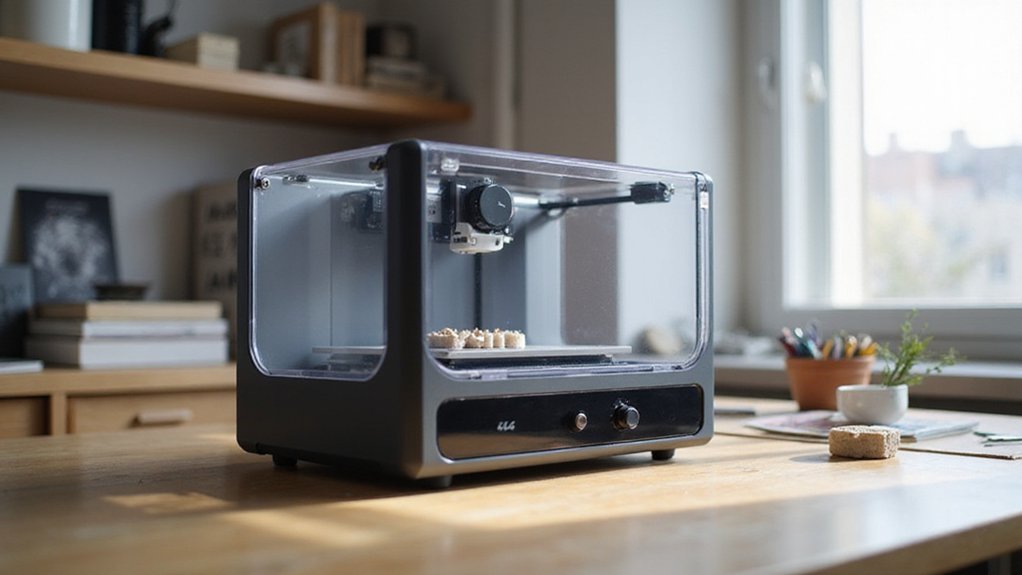
If you’re curious about how to create highly detailed and smooth 3D prints, an SLA printer might be what you need. It uses UV light to cure liquid resin layer by layer, producing precise results perfect for prototypes, jewelry, and dental models.
Stay with me, and I’ll walk you through everything you need to know about this powerful technology.
What Is SLA 3D Printing and How Does It Work?
SLA 3D printing, which stands for stereolithography, is a resin-based process that transforms digital models into highly precise physical objects. It works by using a vat of liquid photosensitive resin that cures when exposed to ultraviolet light. The process begins with a CAD model that is sliced into thin, horizontal layers. A UV laser selectively scans each layer, solidifying the resin in detailed, specific areas. After each layer, the build platform moves slightly to create space for the next. Once printing is complete, the parts are washed to remove excess resin and then UV cured further to ensure full solidification. SLA is known for producing smooth, detailed, and watertight parts, making it ideal for prototypes and intricate designs. Although generally more expensive than filament-based methods, its higher accuracy often justifies the cost. The environmental impacts include resin waste and energy consumption, which are important factors to consider when choosing this technology. Additionally, advancements in resin formulations are helping reduce waste and improve overall sustainability of SLA processes. As research continues, the development of more biodegradable resins may further lessen its environmental footprint.
The Core Components of SLA Printing Technology
The core components of SLA printing technology include the resin vat, build platform, UV light source, galvo system, and supporting hardware. The resin vat holds the liquid photopolymer resin, often made with a transparent bottom to transmit UV light effectively for resin curing. Maintaining tank cleanliness is crucial because dirt or cured resin buildup can obstruct light transmission, leading to inconsistencies in curing and affecting dimensional accuracy. The build platform supports the object during printing and moves precisely along the Z-axis, ensuring each layer has a uniform thickness and proper adhesion. Additionally, the photopolymer resin is specially formulated to respond to UV light, ensuring accurate curing and high-quality prints. The UV light source, typically a laser, initiates photopolymerization by focusing on tiny spots, which determines the XY resolution and fine surface detail. The laser’s spot size, often in the range of 50 to 150 micrometers, directly impacts the printed part’s resolution. The galvo system directs the laser quickly and accurately across each layer, enabling rapid curing at specific points while maintaining precision. Proper calibration of these components is essential for achieving high-quality prints, as slight misalignments can significantly affect the final outcome. When these components work together seamlessly, they produce high-resolution, detailed 3D prints with smooth surfaces and intricate features. Ensuring optimal system calibration is vital for achieving consistent and precise results in SLA printing.
What Sets SLA Apart: Precision, Surface Finish, and Detail
SLA stands out primarily for its ability to produce parts with exceptional precision, smooth surfaces, and intricate details. Its high layer resolution, typically between 25 and 100 microns, allows you to create finely detailed features such as sharp edges, delicate engravings, and thin walls. The surface finish is especially smooth because of these fine layer heights combined with advanced UV curing, which minimizes stair-stepping effects. Industrial SLA printers can achieve surface roughness levels around Ra 1 to 5 microns, comparable to injection-molded parts. This level of accuracy enables the reproduction of complex geometries and tiny features down to 10 to 50 microns. Overall, SLA’s combination of precision, surface quality, and detail makes it ideal for prototypes, presentation models, and detailed components. Layer resolution plays a crucial role in achieving these high-quality results, especially in the reproduction of tiny geometries and features.
Materials Used in SLA Resin Printing
Liquid photopolymer resin is the primary material used in SLA 3D printing. It cures layer by layer when exposed to UV light, transforming from a liquid into a solid part. The resin composition includes monomers, oligomers, photoinitiators, and additives. Each component is carefully selected to achieve properties like clarity, strength, or flexibility. During the curing process, UV light triggers a chemical reaction that creates a thermoset polymer. Different resin types are available for specific needs: standard resins offer fine detail and smooth finishes, while engineering and specialty resins provide enhanced strength, heat resistance, or biocompatibility. Formulations based on epoxy, vinyl, or acrylic chemistries enable parts with diverse mechanical, thermal, and optical properties. The choice of resin depends on your application, desired performance, and surface quality requirements.
Which Industries Use SLA 3D Printing?
SLA 3D printing is used across a wide range of industries due to its high resolution and smooth surface finish. In healthcare and dental fields, it’s essential for creating detailed medical models, patient-specific prosthetics, surgical guides, and dental restorations where precision is vital. The automotive and aerospace industries rely on SLA for rapid prototyping, detailed design verification, wind-tunnel models, and low-volume functional parts, allowing you to validate designs before moving to mass production. Consumer products and electronics benefit from SLA’s ability to produce intricate prototypes of household goods, electronic housings, and small-batch components, enabling quicker iterations that support marketing efforts. Jewelry, art, and fashion industries use SLA to craft complex jewelry pieces, cultural replicas, and decorative accessories with high detail. Additionally, industrial design, education, and architecture utilize SLA for producing high-precision models, prototypes, and scaled visualizations, aiding in thorough analysis and planning.
Pros and Cons of SLA 3D Printers
SLA 3D printers produce high-quality, detailed parts with exceptional surface finishes, but they come with several limitations. The initial investment is typically higher than other types of 3D printers, mainly because they require specialized resin materials and precise optical components. Photopolymer resins used in SLA are more expensive than filaments or powders used in other methods, adding to ongoing costs. Post-processing steps such as washing, support removal, and UV curing increase both the time and effort needed to complete a print. Many SLA resins are also brittle and sensitive to UV light, which can limit the durability and long-term stability of the finished parts. Support structures are often necessary for complex geometries, yet they can leave marks or require additional finishing. The build volume of SLA printers is usually smaller, restricting the size of parts you can produce in a single print. While SLA excels at creating aesthetically refined and highly detailed objects, it is less suitable for functional or load-bearing applications due to the fragile nature of its materials and the careful handling required during printing and post-processing. Additionally, resin storage and handling are crucial aspects to consider to prevent issues caused by moisture absorption and degradation of the material. Proper material management is essential to maintain consistent print quality and extend the lifespan of your resins. Furthermore, understanding resin curing processes is vital for achieving optimal results and durability in the final objects.
How to Select the Right SLA Printer for Your Projects
The ideal SLA printer for your projects depends on your specific needs. Start by identifying your primary use, such as dental models, jewelry, or miniatures, since different applications require varying levels of accuracy and resolution. For detailed work like miniature or jewelry printing, look for an XY resolution of around 35 to 50 microns, which ensures fine detail. If your projects are more general or larger, a resolution of 50 to 80 microns may suffice. Additionally, laser engravers for beginners can offer valuable insights when considering multifunctional tools that combine laser engraving with 3D printing capabilities. Understanding the resin chemistry used in SLA printing can also influence your choice, especially regarding safety and material properties.
Consider the build volume carefully. Match it to the size of your typical projects and batch quantities. For small batch production or desktop use, a compact build volume works well, but if you need larger parts or higher volume output, explore industrial options with bigger dimensions. Compatibility with popular slicing software, such as Chitubox or Lychee, can streamline your workflow and reduce setup time. Also, choosing a cost-effective resin can impact your overall project budget and operational efficiency.
Pricing is not just about the upfront cost. Evaluate long-term expenses, including resin refills, maintenance, and technical support. Practical features like reliable customer support, straightforward maintenance routines, and user-friendly interfaces will help you maintain efficiency and improve your print results over time.
Tips for Achieving Better Results With SLA Resin Printing
Achieving optimal results with SLA resin printing requires precise setup and calibration. Start by carefully leveling the build plate before each print; poor leveling leads to failed first layers and print failures. Conduct exposure calibration for each resin type and color to identify the best settings, as these vary by material and machine. Use a layer height around 50 micrometers for detailed prints, and increase the exposure on bottom layers to improve adhesion. Supports should be placed strategically to stabilize delicate features and reduce marks during cleaning. Maintain a controlled environment by keeping temperatures stable, humidity low, and resin properly conditioned, ensuring consistent results. For color customization, adjust exposure times or support placement to enhance aesthetics without weakening the overall structure. Additionally, understanding SLA 3D printer principles can help troubleshoot common issues and improve overall print quality.