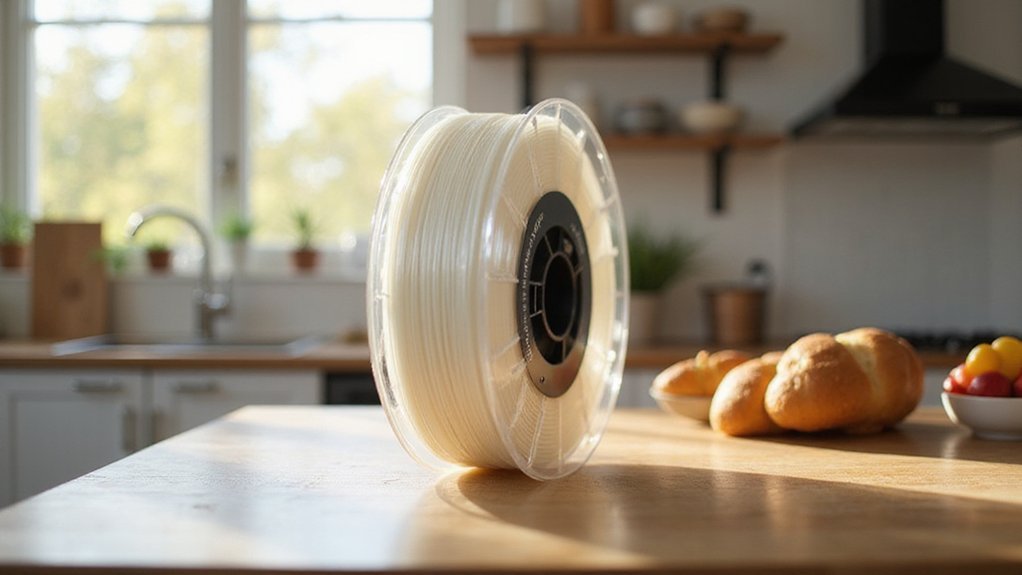
Wondering if PETG filament is safe to use for food-related projects? The truth is, it can be, but only if it meets strict food-contact standards and comes with proper certifications.
Getting this right means paying close attention to labeling, handling, and sealing your prints to prevent any health risks.
Keep reading to learn what you need to know to keep your food-safe creations truly safe.
What Is PETG Filament and When Is It Food Safe?
PETG filament can be food safe, but only if it has the proper certifications and meets strict manufacturing standards. Not all PETG is suitable for food contact applications. To determine if it is safe, you need to verify whether the filament is FDA-compliant or has other relevant food safety certifications. Some brands produce formulations specifically designed for food contact, but verification on each spool is essential. Look for labels or documentation indicating the filament’s compliance with food safety standards. Durability, chemical resistance, and water resistance make PETG a good candidate for containers and items that hold or come into contact with food—again, only if the filament is certified accordingly. Additionally, food safety standards vary between manufacturers, so it’s important to confirm that the specific filament you choose adheres to recognized certifications.
What Are the Main Risks of 3D-Printed PETG Parts in Food Contact?
Chemical leaching is the primary risk associated with 3D-printed PETG parts in food contact applications. Even if the filament is labeled food-safe, additives such as colorants, stabilizers, or plasticizers may not have undergone rigorous testing for ingestion safety. These substances can migrate from the filament into food or liquids under certain conditions, potentially leading to health concerns. Additionally, the manufacturing process can leave residual monomers or unreacted compounds within the printed layers that might leach out over time. Moreover, storage conditions such as exposure to heat and humidity can increase the likelihood of chemical migration. Microbial growth presents another significant risk, especially since layer-line porosity in 3D-printed parts can trap residues and bacteria. Without thorough cleaning and proper surface finishing, these areas become hotspots for contamination. Repeated washing and exposure to moisture can further compromise the surface integrity, making it easier for bacteria to establish and survive. Printer hardware components, like brass nozzles, may also introduce contaminants such as lead or other metals, even if the filament promises food safety. Heat and time exacerbate these risks, as high temperatures during printing can cause additives to degrade or leach more readily, and repeated use can worsen surface porosity. Without suitable post-processing steps, such as sealing or smoothing the layer lines, surface scratches and porosity can harbor germs, increasing the risk of foodborne illness. Proper surface treatment methods and careful handling are essential to minimize these hazards, especially considering how layer-line porosity can affect the safety of printed items. Ensuring thorough cleaning and surface finishing techniques can significantly reduce the risks associated with microbial growth and chemical leaching.
How Can You Make PETG Food Safe for Contact Use?
To make PETG food safe for contact use, start by selecting a filament from a reputable supplier that clearly documents its food-contact compliance. Avoid specialty blends with additives like carbon fiber, which can harbor contaminants. Opt for natural, undyed filament, and request full disclosure of resin ingredients to ensure it meets CFR 21 standards for food safety. Use a stainless-steel nozzle and keep a dedicated printer to prevent cross-contamination between food-safe and non-food-safe parts. Adjust print settings to lower surface porosity by increasing extrusion temperature or optimizing layer bonding, which reduces microscopic gaps that bacteria could hide in. After printing, smooth the surfaces with 320 to 400 grit sandpaper, then finish with 600 grit for a refined surface. Applying a food-safe sealant or epoxy and allowing it to fully cure creates a protective barrier against surface porosity and surface contaminants, further enhancing safety.
Best Practices for Printing and Sealing PETG for Food Safety
To ensure food safety when printing with PETG, it’s crucial to follow proper sealing practices. Start by selecting natural or undyed PETG filament, as colorants and specialty fillers may not be certified for food contact and could leach chemicals. Always verify the manufacturer’s certifications and review technical data sheets to confirm the filament’s suitability for food-related applications. Dedicate your hotend, nozzle, and other printing components solely for food-safe prints to prevent contamination.
Thoroughly clean all equipment between prints to eliminate residual contaminants. Use cleaning agents compatible with food safety standards and ensure your tools are free of debris or leftover filament. Print at lower temperatures, typically around 230°C to 240°C, to reduce thermal degradation and improve layer bonding, which helps minimize internal voids where bacteria could thrive. Resin 3D printers can also be used for creating highly detailed molds and containers that are easier to seal effectively, further enhancing food safety. Additionally, understanding transfer tape can help in creating secure seals on food contact surfaces, making your projects safer and more reliable.
Once the print is complete, sand the contact surfaces with fine-grit sandpaper to smooth any rough areas. Follow by applying a food-safe epoxy coating, covering all contact surfaces completely and allowing the coating to cure fully according to the manufacturer’s instructions. Proper sealing reduces porosity in the final print, limiting microbial penetration and decreasing the risk of chemical leaching if the object comes into contact with food. Incorporating testing procedures can also help verify the safety of your sealed prints and ensure they meet food contact standards.
When Is PETG Not Recommended for Food-Related Applications?
PETG is not recommended for prolonged food contact or repeated dishwashing. Over time, residues can become trapped in layer lines and microstructures, increasing the risk of cross contamination. Repeated washing can erode the surface integrity, making cleaning less effective and providing more hiding places for bacteria. Hot food or liquids, as well as dishwasher use, pose additional problems because heat causes deformation and damages the surface, which can lead to bacterial retention and contamination. Additionally, PETG is unsuitable for direct-contact tableware or utensils that hold food for extended periods, as residues may linger and support bacterial growth. If PETG contains colorants or fillers, these additives could leach into food, especially with repeated exposure, raising safety concerns. Uncoated PETG, in particular, can harbor residues or leachable substances that compromise food safety. Furthermore, layer lines and microstructures can trap residues, making thorough cleaning difficult and increasing contamination risks. Because of these concerns, food safety standards emphasize the importance of careful material selection for food-related items.