Have you ever wondered why your 3D printer isn’t reaching its full potential? The answer often lies in upgrading to the right stepper motors. These tiny powerhouses control your printer’s movements with precision, whisper-quiet operation, and reliability—if you pick the right ones. From NEMA 17 models with ample torque to pancake variants designed for tight spaces, choosing the best stepper motors can dramatically improve your prints and keep things running smoothly. Ready to see what makes a motor a must-have?
| StepperOnline Nema 17 2A 55Ncm 3 Pack |  | High Torque Power | Step Angle: 1.8 degrees | Lead Wires: 4 leads | Power Supply Voltage: 12V | VIEW LATEST PRICE | Read Our Analysis |
| MAKERELE NEMA 17 Stepper Motor for 3D Printers |  | Compact Precision | Step Angle: 1.8 degrees | Lead Wires: 4 leads | Power Supply Voltage: 3.4V | VIEW LATEST PRICE | Read Our Analysis |
| Creality 42-40 Stepper Motor for 3D Printers |  | Reliable Performance | Step Angle: 1.8 degrees | Lead Wires: 4 leads | Power Supply Voltage: 10V | VIEW LATEST PRICE | Read Our Analysis |
| Creality 42-40 Stepper Motor for 3D Printers | Official Quality | Step Angle: 1.8 degrees | Lead Wires: Not specified (implied 4 leads) | Power Supply Voltage: 3V | VIEW LATEST PRICE | Read Our Analysis | |
| Stepperonline NEMA 17 Stepper Motor (5pcs 48mm) |  | Bulk Value | Step Angle: 1.8 degrees | Lead Wires: 4 wires | Power Supply Voltage: Not specified | VIEW LATEST PRICE | Read Our Analysis |
| Stepperonline Nema 17 Pancake Stepper Motor (23mm) |  | Pancake Design | Step Angle: 1.8 degrees | Lead Wires: 4 wires | Power Supply Voltage: 12V | VIEW LATEST PRICE | Read Our Analysis |
| Creality 3D Printer 42-40 Stepper Motor (E Axis) | Compatibility Leader | Step Angle: 1.8 degrees | Lead Wires: Not specified (implied 4 leads) | Power Supply Voltage: 10V | VIEW LATEST PRICE | Read Our Analysis |
More Details on Our Top Picks
StepperOnline Nema 17 2A 55Ncm 3 Pack
If you’re upgrading your 3D printer and need high torque power, the StepperOnline Nema 17 2A 55Ncm 3 Pack is just what you want. These motors are perfect for applications like extruders, CNC machines, and precise movement tasks. Each motor measures 42 by 42 millimeters and weighs about 400 grams. They feature four leads with 1000mm cables, which makes wiring flexible. With a step angle of 1.8 degrees, they give you 200 steps per revolution, ensuring accuracy. The holding torque of 55 Ncm means strong, reliable performance. Plus, they operate smoothly at 12 volts and reach speeds up to 200 RPM—great for most 3D printer upgrades!
- Step Angle:1.8 degrees
- Lead Wires:4 leads
- Power Supply Voltage:12V
- Shaft Diameter:5mm
- Rated Current:2A
- Application Compatibility:3D printers, CNC, extruders
- Additional Feature:High-quality metal construction
- Additional Feature:Suitable for precise movement control
- Additional Feature:Capable of reaching 200 RPM
MAKERELE NEMA 17 Stepper Motor for 3D Printers
Looking for a stepper motor that combines compact precision with reliable performance? The MAKERELE NEMA 17 fits the bill perfectly. With its size of 42x42x40mm and a 5mm shaft, it’s designed for tight spaces without sacrificing power. It features a 1.8-degree step angle for smooth, precise control and delivers a strong 44Ncm of torque. Plus, it’s built with quality copper wire coils for consistent, durable operation. Perfect for 3D printers, CNCs, or laser engravers, this motor delivers steady movement, long-lasting stability, and easy installation thanks to its 1-meter cable and connector. It’s a smart upgrade choice for dependable performance!
- Step Angle:1.8 degrees
- Lead Wires:4 leads
- Power Supply Voltage:3.4V
- Shaft Diameter:5mm (4.5mm shaft diameter)
- Rated Current:1.7A
- Application Compatibility:3D printing, CNC, laser engraving
- Additional Feature:Strong overload capacity
- Additional Feature:Compact and space-efficient design
- Additional Feature:Long-lasting durability
Creality 42-40 Stepper Motor for 3D Printers
The Creality 42-40 Stepper Motor is a reliable performer, perfect for upgrading your 3D printer’s axes. It’s designed to fit models like the CR-10 series and Ender-3, offering a smooth, precise motion. With a D-shaped shaft, 1.8-degree step angle, and 0.4 N·m torque, it provides the power needed for accurate prints. Weighing just 290 grams, it runs quietly at 40 RPM, ensuring minimal noise during long printing sessions. Its metal build guarantees durability, while high-efficiency heat dissipation keeps it running cool. In short, it’s a smart choice for those looking to boost precision and stability without breaking a sweat!
- Step Angle:1.8 degrees
- Lead Wires:4 leads
- Power Supply Voltage:10V
- Shaft Diameter:5mm (D-shape)
- Rated Current:1A
- Application Compatibility:3D printers, CR-10, Ender series
- Additional Feature:Designed for X, Y, E axes
- Additional Feature:High transmission efficiency
- Additional Feature:Fits seamlessly with gears and belts
Creality 42-40 Stepper Motor for 3D Printers
The Creality 42-40 stepper motor stands out as an official quality upgrade for your 3D printer’s precision needs. It’s compatible with many Ender series and CR-10 models, like the Ender 3, Ender 5, and CR-10 V3, giving you a reliable upgrade choice. This motor’s technical specs are impressive: a 1.8-degree step angle, 0.4 N·m torque, and a sturdy aluminum housing for heat dissipation. It runs quietly while maintaining accurate filament extrusion, thanks to its synchronous gear assembly. If you want consistent, precise prints with minimal vibration, the Creality 42-40 is a dependable, high-quality upgrade for your hotend’s E-axis.
- Step Angle:1.8 degrees
- Lead Wires:Not specified (implied 4 leads)
- Power Supply Voltage:3V
- Shaft Diameter:5mm (D-shape)
- Rated Current:1A
- Application Compatibility:3D printers, Ender, CR models
- Additional Feature:Official Creality product
- Additional Feature:Supports multiple printer models
- Additional Feature:Aluminum housing for heat dissipation
Stepperonline NEMA 17 Stepper Motor (5pcs 48mm)
If you’re upgrading your 3D printer and want a dependable, cost-effective set, the Stepperonline NEMA 17 motors offer bulk value with no compromises. These five pieces pack a punch with a 48mm length, bipolar configuration, and rated 2A current. Their 59Ncm torque ensures precise movement without sacrificing speed—up to 200 RPM. Designed for moderate torque needs, they fit NEMA 17 mounts perfectly. Simple to wire, with four leads, these motors deliver consistent, reliable performance for print accuracy. Whether you’re building or upgrading, having a spare set like this guarantees you’ll keep printing without waiting for replacements.
- Step Angle:1.8 degrees
- Lead Wires:4 wires
- Power Supply Voltage:Not specified
- Shaft Diameter:5mm
- Rated Current:2A
- Application Compatibility:3D printers, CNC
- Additional Feature:Moderate torque and reliable performance
- Additional Feature:Recognized within scientific equipment
- Additional Feature:Suitable for CNC applications
Stepperonline Nema 17 Pancake Stepper Motor (23mm)
Looking to upgrade your 3D printer with a compact yet powerful stepper motor? The Stepperonline Nema 17 Pancake Stepper Motor (23mm) is a great choice. Its small size of just 42 by 42 millimeters makes it easy to fit into tight spaces without sacrificing torque. With a rated current of 1 amp and a torque of 17 Ncm, it offers precise movement for detailed prints. It features four wires, so connect it carefully to a compatible driver—no direct power supply hookups! Capable of reaching 200 RPM, it’s perfect for high-precision tasks, especially when weight and space are prime concerns.
- Step Angle:1.8 degrees
- Lead Wires:4 wires
- Power Supply Voltage:12V
- Shaft Diameter:5mm
- Rated Current:1A
- Application Compatibility:3D printers, CNC
- Additional Feature:Small size, high torque
- Additional Feature:Includes cable and connector
- Additional Feature:Precise positioning suitable for 3D printers
Creality 3D Printer 42-40 Stepper Motor (E Axis)
For those seeking the compatibility leader in stepper motors, the Creality 42-40 E Axis motor can be a game-changer. It’s designed to fit a wide range of Ender and CR series 3D printers, including popular models like Ender-3, Ender-5, and CR-10 series. With a 1.8-degree step angle and 0.4 N·m torque, it offers smooth, precise movements, especially for the extruder and other axes. Weighing around 290 grams and built with durable metal, this motor ensures low noise and efficient heat dissipation. It’s reliable and high-performing—perfect for upgrading your printer’s reliability and precision without fuss.
- Step Angle:1.8 degrees
- Lead Wires:Not specified (implied 4 leads)
- Power Supply Voltage:10V
- Shaft Diameter:5mm (D-shape)
- Rated Current:1A
- Application Compatibility:3D printers, extruders, axes
- Additional Feature:High stability and low noise
- Additional Feature:Reliable for extrusion tasks
- Additional Feature:Metal construction for durability
Factors to Consider When Choosing Stepper Motors for 3D Printer
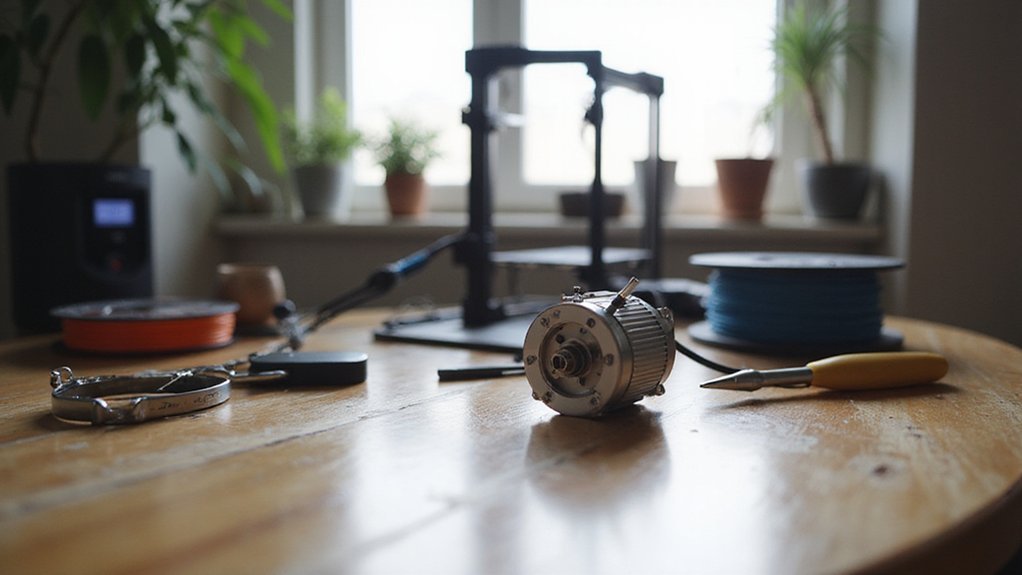
When choosing stepper motors for your 3D printer, you’ll want to think about several key factors. Things like motor torque, compatibility with your specific model, electrical specs, noise levels, and the size or mounting options all play a role in how well your upgrade will perform. Keep these points in mind, and you’ll be on your way to smoother, more reliable prints!
Motor Torque Requirements
Understanding motor torque requirements is essential when upgrading your 3D printer because the right amount of torque directly affects how smoothly and accurately your printer moves. If you go too low, you risk missed steps, uneven extrusion, or slipping on axes—especially with larger or flexible filaments. Most printers need stepper motors with at least 44 Ncm (62 oz.in) of holding torque for reliable operation. But don’t just settle for the minimum—bumping it up slightly offers a safety margin for load variations. Remember, the torque needed depends on factors like the size, weight, and mechanical advantage of moving parts, as well as speed and resolution. So, choosing a motor with the right torque ensures smooth, precise prints every time!
Compatibility With Printer Models
Matching a stepper motor to your specific 3D printer model involves more than just picking a popular size. You need to confirm the motor’s physical dimensions fit your setup, like NEMA 17 or pancake sizes, so it mounts without fuss. Check the shaft type—D-shape or round—to make sure your gears or pulleys grip properly. Additionally, verify the rated current and voltage are supported by your control board and drivers; if they’re mismatched, you’re in for trouble. Also, confirm the motor’s role—whether it’s for the extruder, XY, or Z axis—matches your printer’s design. Finally, review the connector type and cable length to ensure wiring connects smoothly, because a mismatch here can turn into a frustrating puzzle!
Electrical Specifications Compatibility
Getting your electrical specifications right is the foundation for a smooth-running 3D printer. First, check that your stepper motor’s voltage and current match your power supply and controller—mismatched specs can lead to damage or poor performance. Pay attention to phase resistance and inductance too; these influence how smoothly your motor runs and how precisely you can control it. Also, make sure the motor’s current rating aligns with your driver’s maximum output—overloading can cause overheating, while too little current means weak torque. Don’t forget to match the step angle, usually 1.8°, with your needed resolution for accurate positioning. Finally, confirm the connectors and wiring compatibility—nothing kills the vibe faster than fiddling with incompatible plugs. Getting these specs right keeps your upgrade smooth and frustration-free!
Noise and Vibration Levels
When choosing stepper motors for your 3D printer, paying attention to noise and vibration levels can make a big difference in your printing experience. Quieter motors often have smoother internal gear designs and smarter current control, reducing the hum and jitter you might find frustrating. Selecting motors with balanced rotors and proper shaft alignment helps cut down on mechanical vibrations that can mess with print quality. Microstepping drivers are a bonus—they break each movement into tiny steps, which cuts noise and vibrations considerably. Motors with lower inductance and resistance also produce less electromagnetic interference, making their operation quieter. And don’t forget mounting—using vibration isolators or dampers can keep noise levels low, and vibrations way down, turning crowded installs into peaceful workspaces.
Size and Mounting Options
Choosing the right size and mounting options for your stepper motors is like picking the perfect shoes—it needs to fit comfortably, support your movements, and match your setup. Make sure the motor size fits your printer’s designated space, like NEMA 17 or smaller for most desktops. Confirm the mounting hole pattern and spacing align with your frame or socket design—otherwise, you’ll be drilling or smashing parts together. Check if the shaft diameter and length suit existing couplings or gears, avoiding awkward fits. Think about the motor’s form factor too; pancake types work well in tight spaces, while standard ones are better for larger axis setups. And don’t forget, the mount’s stability should support precise, vibration-free printing without extra fuss.