Ever wonder how a self-healing cutting mat works? You might assume it just repairs itself somehow, but there’s actually a clever layer system behind the magic.
By understanding how these mats bounce back from cuts, you can keep yours in top shape and make the most of its lifespan.
Keep reading to see how you can care for and maximize your mat’s self-healing abilities.
What Are Self-Healing Cutting Mats Made Of?
Self-healing cutting mats are primarily made from polyvinyl chloride (PVC), which provides the necessary durability and flexibility for repeated cuts. The construction involves layered structures, including a soft surface layer that absorbs blade pressure, a reinforced middle core that prevents full blade penetration, and a non-slip backing for stability during use. During manufacturing, these layers are bonded together to form a resilient and stable surface that can withstand extensive use. The top layer’s design allows it to recover from shallow cuts, giving the mat its self-healing properties. Some mats incorporate alternative materials such as thermoplastic elastomers or synthetic rubbers, often in more affordable options. Variations in the material blends influence how well the surface heals and how durable the mat remains over time, ensuring you get a long-lasting surface that maintains smoothness after multiple cuts. Material blends play a crucial role in balancing healing ability and overall durability of the mat. Additionally, the layered structure is carefully engineered to optimize both flexibility and resilience, making these mats suitable for various crafting tasks. The self-healing process involves the microcapsules within the surface layer that enable the material to recover after minor cuts.
How Do Self-Healing Surfaces Close After Cutting?
When you cut into a self-healing mat, the surface doesn’t fully slice through. Instead, the blade presses against the surface, leveraging the material’s flexibility. The softer outer layer parts temporarily part, creating a micro-gap that allows the blade to pass between tiny structures within the material. Once you remove the blade, the surface’s inherent resilience causes it to relax back into its original shape. This elasticity closes the groove almost immediately, restoring a smooth surface. Additionally, the elastic properties of the material enable it to recover after cutting, making it suitable for repeated use. The layered design often includes a hard core with softer top layers that facilitate this process. This structure helps the material absorb the impact of cutting and recover quickly. Because the material’s elastic properties are at work, the tiny cut becomes less visible over time. Materials like PVC or polyurethane are good examples—they bend and recover easily, maintaining a flat, cut-resistant surface. This self-healing ability reduces permanent damage and allows you to reuse the mat multiple times without it becoming noticeably scarred.
Best Ways to Use Your Self-Healing Mat
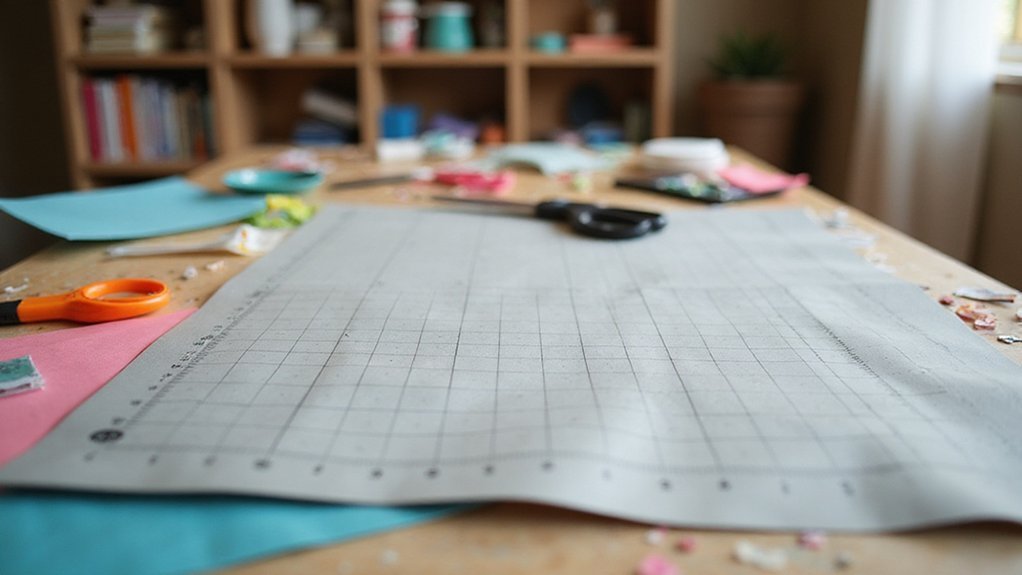
To ensure the best results with your self-healing mat, start by setting up a flat, smooth work surface. Make sure the mat lies completely flat without any overhang, as a stable and level table prevents shifting or warping during cutting. Proper positioning of fabric is also crucial: spread it flat on the mat and align it precisely with the grid lines or bias marks to achieve accurate cuts. Use a sturdy ruler, holding it firmly in place, to guide your rotary cutter smoothly along the measurement lines. Apply even pressure with a sharp rotary cutter to produce clean, consistent cuts, moving steadily alongside the ruler edge. Regularly remove trapped fibers and clean the surface to maintain visibility and optimal functionality. Surface maintenance tips can help prevent debris buildup and prolong the life of your mat. A well-organized workstation not only improves your control and accuracy but also extends the life of your self-healing cutting mat. Proper maintenance and cleaning of your mat are also essential for preserving its surface and ensuring long-lasting performance, especially since self-healing capability allows it to recover from minor cuts and punctures over time.
How to Maintain and Extend Your Mat’s Life
Regular cleaning is essential to keep your cutting mat in top condition and extend its lifespan. Use a soft cloth or brush to gently wipe the surface every two weeks if you use it lightly. For more frequent cleaning, such as when you notice fuzz, grime, or stains, do so as needed. Clean with cool or lukewarm water, adding a small amount of white vinegar or mild dish soap, then rinse thoroughly to remove residue. To restore and hydrate your self-healing mat, soak it in water for 15 to 20 minutes, making sure the water isn’t hot. Always air-dry your mat flat in a shaded area, avoiding direct sunlight, to prevent warping and preserve its shape. Store it flat and away from heat sources to prevent deformation. Rotating your mat regularly and keeping your blades sharp also helps maintain cutting precision. Using eco-friendly cleaning materials and proper maintenance practices can significantly prolong your mat’s useful life and optimal performance. Proper storage practices prevent warping and damage over time, helping maintain your mat’s integrity for longer periods.
Common Mistakes That Shorten Your Mat’s Lifespan
Exposing your self-healing cutting mat to heat sources or direct sunlight can significantly shorten its lifespan. The mat’s material includes self-healing layers that soften and lose tension above 90°F (32°C), leading to permanent fading of grid lines and warping that cannot be reversed. Placing the mat in hot cars, near radiators, or under mugs speeds up deformation, making it unsuitable for precise cuts. Dull blades or pressing too hard leave deep grooves that the surface cannot repair, reducing its effectiveness. Using harsh chemicals like acetone or bleach can erode the material over time, damaging the surface. Improper storage—such as keeping it upright or on unstable surfaces—causes warping and creases that hinder the mat’s healing ability. To extend its life, store your mat flat and in a cool, shaded place, and avoid exposure to heat and direct sunlight. Additionally, avoiding excessive cleaning with abrasive materials helps preserve the surface integrity. Additional mistake to avoid Leaving the mat in place after use and allowing imperfections to build up over time can also compromise its self-healing properties, reducing its ability to recover from cuts and surface damage. Regularly inspect and maintain your mat to keep the surface smooth and durable for ongoing use.