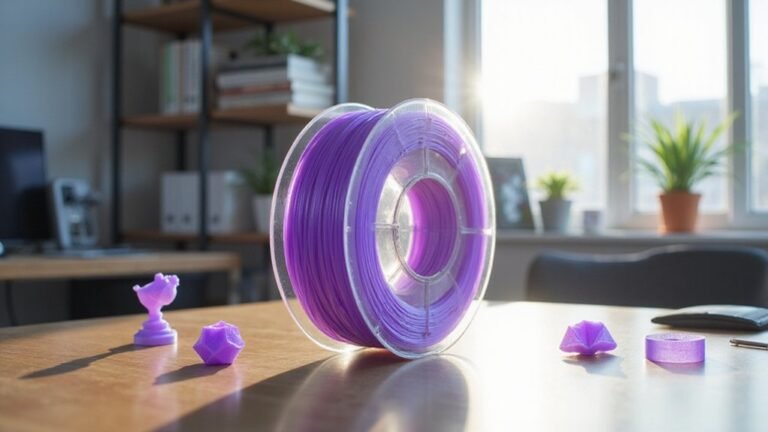
If you’re wondering what makes PLA filament a top choice for 3D printing, you’re not alone. It’s favored for its simplicity, eco-friendliness, and ability to produce detailed prints with minimal warping.
Whether you’re a beginner or looking to refine your skills, understanding PLA helps you craft better, more sustainable projects.
Keep reading to discover everything you need to know.
What Is PLA Filament and How Is It Made?
PLA filament is produced through a multi-step process starting with raw plant-based feedstocks like corn starch or sugarcane. These sources are first broken down into simple sugars via wet milling. The sugars are then fermented using bacteria such as Lactobacillus, which convert them into lactic acid. This lactic acid undergoes polymerization through ring-opening polymerization, resulting in PLA resin. The resin is then processed into small pellets, dried to remove moisture which can compromise print quality, and fed into an extruder. The extruder melts and forces the resin through a heated nozzle, shaping it into filament. The filament is then cooled, spooled onto rolls, and carefully inspected to ensure consistent diameter and quality, ready for use in 3D printing. Additionally, polymerization process is crucial in determining the final properties of the PLA filament, such as strength and biodegradability. The entire production process significantly impacts the filament’s mechanical properties, influencing how well it performs during printing.
Why Is PLA a Beginner-Friendly Filament? Key Properties Explained
PLA is considered the most beginner-friendly filament because of its low-print-temperature range. It typically prints at 180–220°C, which is easier to manage compared to other materials. This wide and forgiving temperature window reduces setup complexity and minimizes calibration mistakes, making it easier for newcomers to achieve successful prints. The low-warpage tendency makes it an attractive choice for those new to 3D printing. PLA also has low warping tendencies and adheres well to unheated beds, increasing the chances of a smooth print. Its tolerance for small errors in temperature or speed means your parts are less likely to fail due to minor adjustments. Additionally, PLA produces clean, sharp details with good dimensional accuracy, resulting in a visually appealing finished product. The extruder mechanism plays a crucial role in ensuring consistent filament flow, which is especially important for those learning the nuances of 3D printing. Its minimal hardware requirements and affordability further make it an accessible choice for beginners transitioning into 3D printing. Ease of use and versatility make it an ideal filament for those just starting out with 3D printing.
How Environmental-Friendly Is PLA? Pros and Cons
PLA is often considered eco-friendly because it is made from plant-based materials like corn starch or sugarcane and requires less energy during production. Its life cycle relies on renewable resources, reducing dependence on petroleum and lowering greenhouse gas emissions compared to traditional plastics. This makes PLA somewhat more sustainable in terms of carbon footprint. However, it still faces environmental challenges. Efficient biodegradation of PLA requires industrial composting conditions, which are not always accessible in everyday settings. Recycling options are limited due to inadequate infrastructure and potential contamination of the material. Moreover, cultivating crops for PLA can compete with food production and contribute to land-use concerns. Although PLA’s production generates a smaller carbon footprint, its overall environmental impact depends heavily on farming methods, transportation, and disposal practices. These factors mean that while PLA is greener than many plastics, it still involves notable environmental trade-offs. Biodegradation requirements must also be considered when evaluating its environmental benefits. Additionally, the availability of industrial composting facilities plays a crucial role in maximizing its eco-friendly potential. The sustainability of PLA is further influenced by farming practices, which can vary significantly and impact the overall environmental footprint.
Where Can You Use PLA, and What Are Its Limitations?
PLA is best suited for indoor applications where low stress, aesthetic appeal, and ease of use are priorities. It performs well in desktop FDM 3D printing, rapid prototyping, decorative models, and consumer product housings. Its ability to produce fine details, combined with low warping and straightforward printing, makes it ideal for creating mockups, display pieces, and short-term packaging.
However, PLA’s limitations restrict its outdoor and high-stress use. Its low heat resistance causes it to soften or deform in hot environments, such as areas exposed to direct sunlight or temperatures above 50°C (122°F). Exposure to UV light, weathering, and moisture accelerates degradation, leading to brittleness and loss of structural integrity over time. Its inherent brittleness also reduces impact resistance, making it unsuitable for parts that need to withstand mechanical shocks or repeated stress.
You should avoid using PLA for load-bearing or durable applications that will encounter high temperatures, prolonged outdoor exposure, or repeated impact. Instead, reserve it for prototypes or aesthetic objects where longevity and outdoor performance are not crucial.
Tips to Get Perfect Prints With PLA Filament
Proper calibration of your printer is essential for accurate dimensions and consistent layer heights. Use a bed leveling procedure to ensure the print bed is perfectly level, which improves first-layer adhesion and surface quality. Regularly check and clean the nozzle to prevent clogs and uneven extrusion, which can cause defects like blobs or gaps. Set the nozzle temperature between 190°C and 220°C—starting at around 200°C—and fine-tune it in 5°C increments based on the surface finish and adhesion quality. Use a heated bed at 50°C to 60°C to enhance first-layer bonding, making sure the bed is clean and properly leveled. Printing at optimal printing speeds of 40 to 60 millimeters per second, slowing down for the first layer to boost adhesion and prevent warping. Keep your filament dry by storing it in a moisture-free environment or drying it at 60°C if you notice popping or bubbling during printing. Ensuring your filament is dry can significantly affect print quality moisture absorption. Additionally, monitoring material storage conditions helps maintain consistent filament performance.