Trying to decide between a sublimation printer and a Cricut can feel overwhelming. Both tools serve different creative needs.
Knowing which one aligns best with your projects can make all the difference. Whether you want vibrant prints or precise cuts, understanding how each works will help you choose the right fit.
The details below will guide you to the option that suits your creative vision.
Which Crafting Workflow Is Right for You: Sublimation or Cricut?
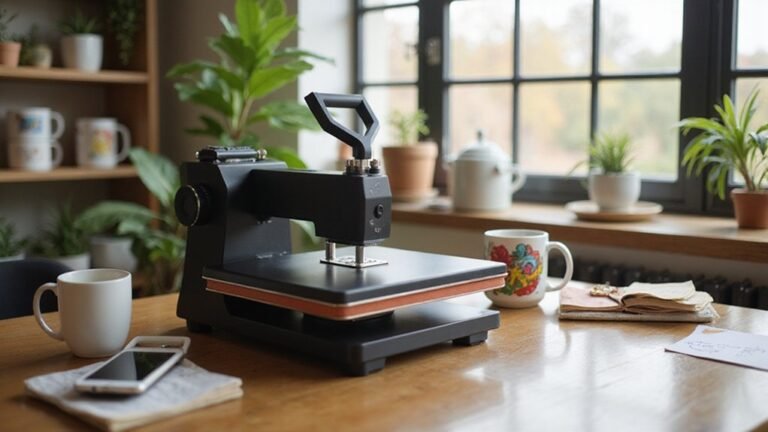
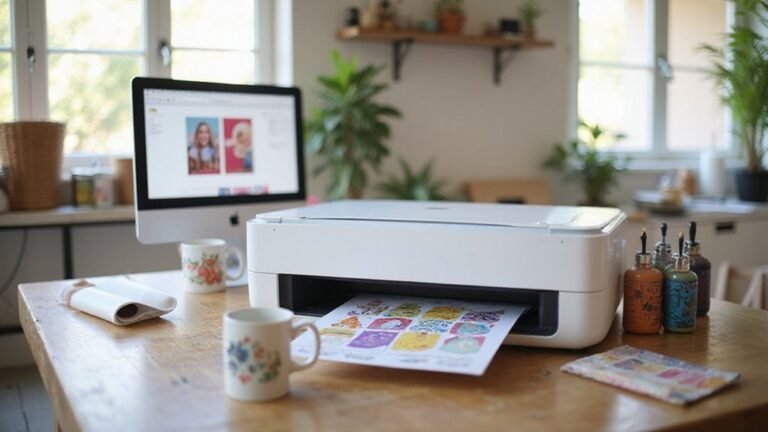
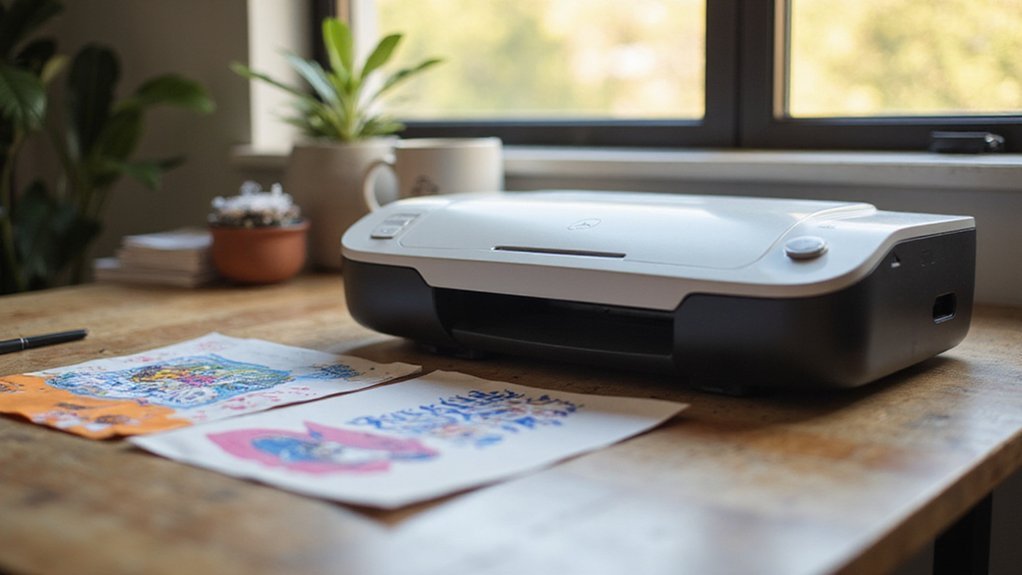
Choosing between sublimation and Cricut depends on your project goals, material access, and safety considerations. Sublimation requires specialized equipment: a dedicated sublimation printer, sublimation inks, a heat press, and substrates with polyester content or coatings. This setup limits your material options but offers vibrant, durable prints on compatible surfaces. It also benefits from being compatible with a variety of 3D printing materials, which can expand your crafting possibilities. The process involves high temperatures around 385–400°F, so you’ll need heat-resistant gloves and good workspace ventilation to prevent burns and fumes. Additionally, understanding the iron-on vinyl compatibility ensures your designs will adhere properly and last over time. For projects involving filament types, such as PET or PETG, sublimation can sometimes be integrated to create multi-material effects, further enhancing your craft versatility.
In contrast, Cricut uses a versatile cutting machine with various blades and materials. It allows you to cut paper, vinyl, iron-on, and other materials without the need for heat presses or specialized inks. Handling blades and cut materials requires caution but generally involves fewer safety concerns than sublimation. It offers more flexibility for a variety of projects and is easier to set up and operate.
Consider your project scope, materials you already have or can easily acquire, and safety habits. If your focus is on high-quality, permanent prints and you’re comfortable with equipment costs and safety practices, sublimation might be the right choice. If you prefer a more flexible, safer craft process with a wide range of materials, Cricut offers a convenient and adaptable workflow.
How Do Design Capabilities Differ Between Sublimation and Cricut?
Design capabilities differ significantly between sublimation and Cricut. Sublimation offers a high level of artwork flexibility, enabling you to print full-color, photo-quality images with smooth gradients, shading, and fine details. It can reproduce complex illustrations and photographs with precision, making it suitable for intricate, highly detailed projects. Sublimation ink bonds at the molecular level with polyester surfaces, allowing for vibrant and durable color reproduction that won’t peel or crack over time. Additionally, the molecular bonding process ensures long-lasting color durability that resists fading, even after many washes. This bonding process is a key factor in the color vibrancy and longevity seen in sublimation prints. While Cricut, by contrast, is primarily a cutting machine designed for simpler designs such as basic shapes, lettering, and bold graphics. Its design complexity is limited to pre-made patterns or straightforward vector graphics, which restricts detailed image reproduction.
The ability to achieve detailed, photo-quality prints is a key advantage of sublimation, emphasizing its strength in complex artwork reproduction. While Cricut allows for creative arrangement of shapes and layering to enhance visual impact, sublimation provides comprehensive control over the entire artwork itself. This means sublimation supports more complex and detailed designs, whereas Cricut excels at producing clean, bold, and impactful cuts quickly and easily. The choice depends on whether your focus is on detailed printed images or on crafting precise cutouts for simple designs.
Which Materials Are Best Suited for Each Crafting Method?
Materials suitable for sublimation are primarily polyester fabrics or synthetic surfaces with a polyester content of 65% to 100%. These materials produce vibrant, long-lasting images because the sublimation ink bonds with the polyester fibers, creating durable, fade-resistant designs. Sublimation works best on light-colored garments and polymer-coated hard surfaces such as mugs, plaques, and metal sheets. Natural fibers like cotton or uncoated surfaces do not hold sublimation ink effectively, resulting in poor image quality or ink flaking off over time. Conversely, Cricut crafts accommodate a wider variety of materials, including paper, vinyl, leather, and various fabrics. Its ability to cut intricate shapes applies to different thicknesses and types, offering flexibility. Cricut does not dye fabrics but instead applies layered vinyl or other adhesive materials, making it suitable for surfaces regardless of color or fiber type. Proper surface preparation is essential to ensure the adhesive vinyl or other materials adhere well and last over time.
How Do Durability and Finish Compare for Sublimation and Cricut Projects?
Durability and finish quality are major factors distinguishing sublimation from Cricut projects. Sublimation creates a seamless, integrated surface where ink becomes part of the material, resulting in a smooth, no-hand-feel finish that is ideal for apparel and hard blanks. The dyes penetrate the fibers, maintaining vibrant colors that resist cracking, peeling, or fading even after multiple washes. Cricut vinyl, however, sits on top of the surface, producing a layered texture that can feel stiff or plasticky to the touch. Although durable enough for seasonal or short-term use, vinyl may peel or crack over time, especially with frequent handling or washing. Cricut Infusible Ink offers a finish similar to sublimation but still requires compatible blanks to achieve that seamless look. Overall, sublimation delivers superior durability in both surface finish and color vibrancy, making it better suited for long-lasting, high-wear projects.
What Are the Cost and Setup Considerations for Each Workflow?
Starting a sublimation or Cricut project involves distinct initial investments and setup steps that significantly influence your overall costs. Sublimation requires a higher upfront investment, with equipment prices ranging from approximately $500 for a basic setup to over $3,500 for professional-grade systems. Assembling a converter inkjet printer with the necessary supplies can cost about $500–$700, whereas dedicated sublimation printers tend to be more expensive initially. Setting up sublimation is more complex, involving printer conversion, ink loading, calibration, and potential facility modifications. Performance and durability are key factors to consider, as sublimation creates long-lasting, vibrant images that are resistant to fading, whereas Cricut materials are typically easier to replace but less durable for certain applications. Additionally, the choice between sublimation and Cricut often depends on the cost and setup considerations, which play a role in determining the most suitable option for your needs. In contrast, Cricut workflows are more straightforward, focusing on purchasing a cutting machine, mats, blades, and materials. The setup process is less involved and quicker to execute. Moreover, the initial investment for Cricut equipment tends to be lower compared to sublimation setups, making it an attractive option for beginners or those with budget constraints. Ongoing expenses for sublimation include ink, transfer paper, and blanks, which can add up over time. Cricut projects mainly incur costs for consumable materials like adhesive vinyl, cardstock, or specialty papers, making it easier to manage and predict ongoing expenses.
How to Decide When to Use Sublimation, Cricut, or Both?
Deciding whether to use sublimation, Cricut, or a combination depends on your project goals, design complexity, and materials. If you want full-color, photo-quality images with fine detail, gradients, or multicolored artwork, sublimation is the best choice because of its superior color accuracy and ability to print directly onto polyester fabrics or coated surfaces. It works well for vibrant, high-resolution images but is limited to materials that are polyester-based or coated for dye absorption.
Cricut is ideal for cutting vinyl, paper, or layered shapes, especially when your design involves decals, intricate cutouts, or text-based projects. It excels with non-sublimation materials and allows you to create precise shapes and layered projects quickly.
When your project combines detailed images with complex cutouts, using both tools together makes sense. For instance, you can print a full-color design with sublimation and then use a Cricut to cut out specific shapes or overlays. Matching the process to your design’s complexity, material compatibility, and workflow needs ensures the best results. Additionally, understanding the performance differences between resin and filament 3D printing can help you choose the right tools for creating durable, high-quality prototypes or finished products.