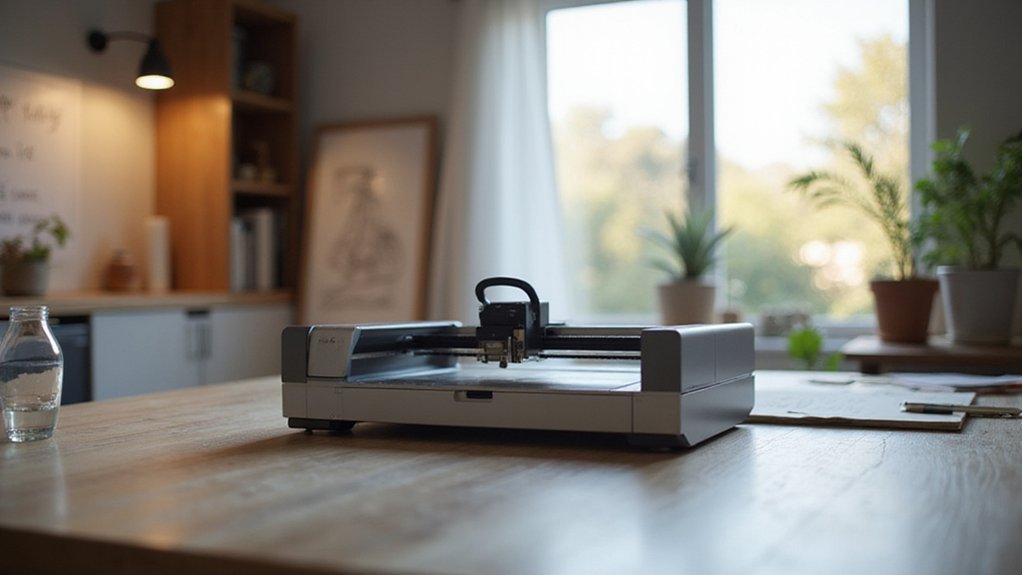
Thinking about using a laser cutter to work with glass? If you hope to cut or shape it, you’ll find that standard CO₂ laser machines mainly engrave and can cause cracks rather than make clean cuts.
For precise cuts, you’ll need specialized ultrafast pulsed lasers designed for delicate materials like glass.
The full story on what works, safety tips, and best practices is just below.
Can a Standard CO₂ Laser Cutter Really Cut Glass?
Can a standard CO₂ laser cutter really cut glass?
A standard CO₂ laser cutter cannot reliably cut through glass. These machines excel at engraving or etching on glass surfaces but are ineffective for full-thickness cuts. Attempting to cut rigid, untreated glass with a typical CO₂ laser often results in thermal shock, causing the glass to shatter or develop microfractures, which damages the workpiece. This is because glass absorbs very little of the laser energy—more than 95 percent of the incident light is reflected rather than absorbed—and this property limits the effectiveness of laser cutting. As a result, the laser cannot transfer enough heat into the material to cut through it cleanly. Instead, uneven heating increases the risk of cracks and breakage, making precise cuts impossible. Even higher-wattage laser systems struggle with thick or coated glass, and attempting to cut glass on standard models is unreliable at best. Usually, a CO₂ laser will be better suited for surface engraving rather than actual glass separation, ensuring both safety and optimal results. Understanding the absorption properties of glass can help clarify why laser cutting is not feasible for full-thickness materials, especially considering material-specific limitations. Additionally, thermal shock resistance plays a crucial role in determining whether a material can withstand laser cutting without cracking.
Which Lasers Are Best for Cutting Glass?
Ultrafast pulsed lasers, specifically picosecond and femtosecond lasers, are the best choice for cutting glass. They produce precise fractures with minimal thermal damage through a process called “cold ablation,” which results in cleaner edges and reduces cracking risk. These lasers typically operate at powers between 10 and 100 watts, making them suitable for high-accuracy work requiring high-quality edges. Additionally, their ability to minimize thermal effects makes them ideal for delicate glass applications. They usually work at wavelengths around 1030 to 1064 nanometers, which are well-suited for glass processing. Laser wavelength plays a crucial role in determining cutting quality and safety, especially when working with different types of glass. Ultraviolet lasers at 355 nanometers are also effective, especially for fine detail work and thin glass, as they utilize nonlinear absorption for controlled separation. While CO₂ lasers excel in surface engraving, they are limited for through-cutting applications. Fiber lasers generally aren’t suitable for glass cutting unless they are specially designed for that purpose. Understanding the laser-tissue interaction is essential to optimize the process and prevent damage during cutting. The ideal laser depends on your specific needs for precision, safety, and the type of glass being processed.
How Do Different Types of Glass Affect Laser Cutting?
Different types of glass impact laser cutting performance significantly. Clear float glass with no coatings allows more laser energy to pass through, resulting in easier engraving and cleaner edges. In contrast, colored or reflective glasses absorb more laser energy, making cutting more challenging and potentially damaging the material. Low-iron and high-purity optical glasses like fused silica offer superior results due to fewer impurities and better optical clarity, producing cleaner, more precise cuts. Borosilicate glass, commonly used in laboratories, responds well to laser engraving and precision work, but thick varieties or those with specific compositions may require adjusted laser settings for optimal results. Additionally, coating effects can hinder laser energy transfer, meaning coated or laminated glasses are less suitable for standard laser cutting. Surface coatings—such as paints or laminates—can hinder laser energy transfer, meaning coated or laminated glasses are less suitable for standard laser cutting. Various glass compositions can influence the overall ease and quality of the laser cutting process.
What Thickness of Glass Can Be Cut With a Laser?
Laser cutting works best on thin to mid-range glass. Typically, glass up to 3 millimeters thick can be cut with good precision, with thin glass around 0.1 to 1 millimeter producing clean, high-quality edges using ultrafast pulsed lasers. For glass between 1 and 3 millimeters, specialized industrial systems can still produce acceptable results, often employing techniques like micro-perforation to improve accuracy. Thicker glass, ranging from 5 millimeters to over 12 millimeters, requires high-power laser systems designed for ultra-thick substrates. Cutting through such thick glass usually involves multiple passes, which increases the risk of cracking and edge chipping. The feasibility of laser cutting at these thicknesses depends heavily on the laser’s power, type, and the process used. Overall, thinner glass consistently offers the best chance for precise, clean cuts with minimal risk, especially when considering glass properties, which affect how the material responds to laser cutting. Additionally, surface quality and material composition can influence the success of the cutting process.
How Much Power Do You Need to Cut Glass With a Laser?
To cut glass effectively with a laser, you need a power level that correlates with the glass’s thickness and type. Generally, for glass under 4 mm thick, a minimum of 80W is necessary, while thicker or tougher glass may require 150W or more. A practical rule of thumb is to use about twice the glass thickness in millimeters, plus an additional 10W—so, 2 mm glass needs around 14W. For more precise and cleaner cuts, ultrafast pulsed lasers in the 10–100W range are suitable, especially for detailed work. Proper laser settings are essential to optimizing glass cutting and ensuring safety during the process. Additionally, understanding the laser-material interaction helps in adjusting parameters for optimal results. Increasing laser power enables faster cutting speeds but must be balanced with the laser’s focus, speed, and other parameters to prevent chipping or poor quality cuts. Maintaining a consistent laser focus can significantly improve the quality of the cut in addition to power adjustments.
What Are the Main Challenges and Risks When Laser Cutting Glass?
Laser cutting glass involves significant challenges primarily due to the material’s susceptibility to thermal stress and cracking. The intense heat generated by the laser can induce microcracks, chips, and unwanted chipping on the exit side of the cut, increasing the risk of damage and breakage. Controlling these microstructural defects requires precise laser settings and technique, making the process complex. Safety is another critical concern; microscopic glass powder, airborne particles, and fine silicate fumes are produced, which pose respiratory hazards and can damage optical components like lenses and sensors. There is also an environmental impact to consider, as these particles can settle on surfaces or disperse into the workspace. Furthermore, the high-voltage machinery used in laser cutting presents risks of electrical shock and injury. Because glass has poor thermal conductivity, heat tends to accumulate during the process, heightening the chances of cracks and other defects. Managing heat distribution and preventing thermal shock are thus essential but challenging. Additionally, understanding the thermal properties of glass is crucial to effectively minimize cracks and defects during cutting. It is also important to consider how material characteristics affect the laser’s ability to achieve a clean cut without damage. Recognizing the material’s thermal behavior can help in developing more effective cutting strategies and equipment adjustments.
How to Prepare and Optimize Your Laser for Cutting Glass
To prepare and optimize your laser for cutting glass, start by selecting a laser system suitable for this delicate task. Ultrafast pulsed lasers, such as picosecond or femtosecond models, are ideal because they minimize heat transfer, reducing the chance of thermal stress and shattering. Ensure your workspace is equipped with proper safety measures, including shielding, goggles rated for the laser wavelength, and adequate ventilation to handle fumes. Using the right type of laser is crucial for achieving clean cuts and preventing damage to the glass. Focus adjustment is a crucial step—accurately setting the focal length ensures precision and cleaner cuts. Use a focus gauge or test with a small piece of similar glass to find the optimal focal point. Adjust the laser power based on the thickness of the glass; thinner glass typically requires lower power to prevent cracking, while thicker glass may need slightly higher settings. Lower power settings often help achieve smoother edges and better control. Set the cutting speed slower for better surface quality and to reduce the risk of cracks or uneven cuts. Conduct trial cuts on scrap glass to fine-tune the parameters—pay attention to the quality of the edges, heat marks, and any signs of stress or cracking. Regularly clean lenses and mirrors to maintain beam quality and prevent energy loss. Monitoring the beam quality during operation can help identify issues early, ensuring consistent results. Incorporating proper maintenance routines can extend the lifespan of your laser equipment and maintain optimal performance. Throughout the process, monitor the laser’s operation for overheating signs, such as smoke or discoloration, and allow cooling if necessary. Proper preparation, including precise focus, tailored power, and thorough safety measures, will help you achieve safe, high-quality cuts with minimal waste or damage.
What Are Common Uses of Laser-Cut Glass in Industry and Crafts?
Laser-cut glass is widely used in industry and crafts because it enables the creation of intricate designs and precise shapes that traditional tools cannot achieve. In crafts, you’ll find it shaping custom mirrors, decorative panels, and bottles, where detailed patterns and fine aesthetics are prioritized. The process is non-contact, meaning it doesn’t exert force on the glass, allowing for delicate and complex forms without risk of breakage. This makes it ideal for artistic projects and small batches that require high detail.
In electronics, laser-cut glass is essential for manufacturing thin sheets, touchscreens, and various components that demand exact dimensions. Architectural applications include creating facades, partitions, and decorative elements with clean, sharp edges and repeatable patterns that boost visual appeal. In industrial environments, laser marking is commonly used to add durable, high-contrast labels, logos, and identification marks directly onto glass surfaces.
When Should You Test and Post-Process Laser-Cut Glass?
Testing should be conducted immediately after laser cutting to identify potential hazards and imperfections. Inspect the edges for sharpness, microcracks, and thermal damage using visual inspection and polarized light microscopy. Measure corner breakout and taper geometry errors with precision tools like calipers or coordinate measuring machines to ensure the cut aligns with design specifications. Detect microcracks early, as they can compromise overall strength, by examining the glass under polarized light. Once initial testing confirms the quality, proceed with post-processing steps such as sanding, polishing, or grinding to smooth edges and remove burrs. After these processes, verify their effectiveness through profilometry to assess surface roughness or bend testing to confirm structural integrity. Final safety measures—including PPE, protective guards, and handling protocols—must be checked before the glass is fully handled or used. Timing these tests and post-processing steps carefully guarantees the final product meets both quality and safety standards.
Is Laser Cutting the Right Method for Your Glass-Shaping Needs?
Laser cutting can be suitable for your glass-shaping needs if you’re working with thin, delicate glass and require detailed patterns or complex geometries. This method offers high precision thanks to its non-contact process, reducing the risk of mechanical stress on the glass. Ultrafast pulsed lasers are particularly effective for achieving clean, precise cuts. However, safety precautions are essential, as laser equipment can pose hazards if not properly managed. The glass’s durability is also a critical consideration; brittle or tempered glass may crack or shatter under thermal stress caused by the laser. For thicker or more robust glass, traditional cutting methods or other fabrication techniques might provide more reliable results. Carefully evaluate your glass type, thickness, and desired intricacy before deciding if laser cutting aligns with your project’s requirements.