Deciding between PETG and PLA can feel confusing if you’re unsure which material suits your project best. Typically, PLA is easier to print and more affordable.
Meanwhile, PETG offers greater strength and heat resistance. Your choice depends on whether you want a simple, decorative model or a durable, outdoor-ready piece.
Keep reading to see how each material matches your specific needs.
Which Filament Is Easier to Print: PETG or PLA?
PLA is generally easier to print than PETG. It requires lower print temperatures, typically between 200–220°C, making it compatible with most consumer 3D printers and straightforward to set up. Its bed adhesion is more forgiving, and it tends to produce less stringing and fewer surface defects. This simplifies troubleshooting for beginners. Additionally, PLA’s lower printing temperatures can help reduce print failures and make calibration easier for newcomers. When considering food safety, PLA is often regarded as a more suitable option due to its safer composition, especially if it is marked as food-safe or food-grade. In contrast, PETG requires higher temperatures, often around 230–250°C, which can complicate setup and increase the risk of print failures. PETG also presents stronger adhesion challenges, especially to the build plate, and tends to string more during printing. While PETG offers benefits like greater toughness and chemical resistance, its more demanding printing process makes it less beginner-friendly. Overall, PLA’s ease of use, broader color options, and eco-friendly attributes make it the preferred filament for those new to 3D printing.
How Do Strength and Impact Resistance Compare Between PETG and PLA?
PETG generally has lower tensile strength than PLA but offers significantly better impact resistance. PLA’s tensile strength ranges from 50 to 70 MPa, making it stiff and resistant to pulling forces but more brittle. PETG’s tensile strength is typically between 40 and 50 MPa, which is slightly lower but still substantial. The key difference lies in their behavior under impact. PLA tends to snap or shatter when subjected to sudden shocks because it is more brittle. PETG, on the other hand, absorbs impact energy by deforming plastically, allowing it to bend or flex without breaking. This ductility makes PETG more resistant to drops, bumps, or repeated shocks. Additionally, understanding material ductility can help in selecting the right filament based on how much impact resistance is needed for your project, especially in applications needing impact absorption. Recognizing how material properties influence performance can be crucial for making an informed choice.
Which Material Performs Better in High Temperatures and Outdoor Conditions?
PETG outperforms PLA in high-temperature and outdoor conditions due to its superior thermal stability and environmental resistance. It maintains strength around 70–80°C, whereas PLA softens at a lower range of 50–60°C. PETG’s higher heat deflection temperature, approximately 70°C, makes it more reliable when exposed to warm environments like sunlight or heated equipment. In outdoor settings, PETG’s resistance to moisture and UV exposure ensures it endures longer, unlike PLA, which degrades more quickly under sun and weather exposure. This durability makes PETG a better choice for functional parts and outdoor fixtures exposed to harsh conditions.
Which Filament Provides the Best Finish and Suited for Visual Models?
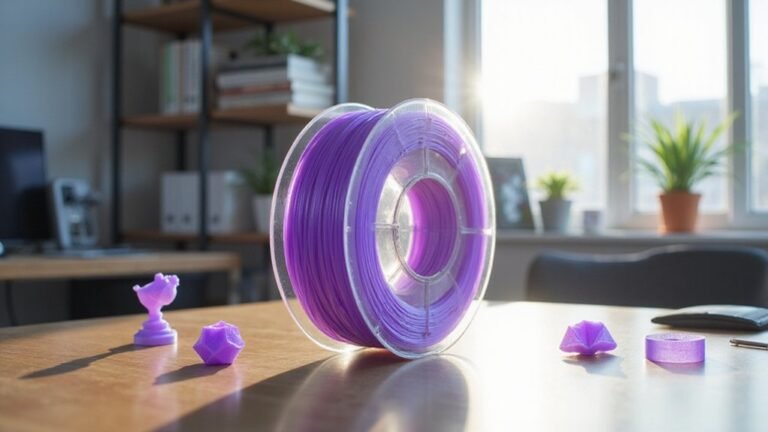
PLA provides the best finish and is most suited for visual models. It delivers a smooth, high-quality surface with crisp edges and minimal stringing, making it ideal for detailed, presentation-ready prints. Its uniform surface allows fine details to stand out clearly, especially on small decorative parts. While PETG can produce a glossy, transparent, and visually striking surface—especially on translucent or clear components—it requires careful tuning to avoid surface roughness or oozing. Overall, PLA generally results in a cleaner, more refined finish with less effort, which is why it’s often preferred for models where surface quality and visual appeal are priorities. Additionally, surface finish plays a significant role in achieving a professional look.
Which Material Is More Cost-Effective and Suitable for Your Needs?
PLA is more cost-effective for most hobbyist needs because it offers the lowest upfront cost, typically around $20 per kilogram. Its affordability makes it accessible for those just starting or working on multiple projects. Additionally, PLA has a longer shelf life when stored in a cool, dry environment, ensuring consistent quality over time. This durability in storage reduces waste and reprints, ultimately saving you money.
In contrast, PETG usually ranges from $25 to $35 per kilogram and is chosen when you need better durability and heat resistance. While its higher cost can seem a drawback initially, PETG’s toughness means fewer failed prints and the ability to produce functional parts that last longer. Its moisture sensitivity requires careful storage to prevent quality issues, which can add to maintenance costs.
For decorative or non-functional models, PLA’s low cost and ease of use make it the best choice. However, if your focus is on creating tougher, heat-resistant components, investing in PETG may be more economical over time despite the higher material expense.