If your PLA filament isn’t printing as smoothly as you’d like, moisture could be the culprit.
Drying it properly can make a big difference in print quality and reduce issues like warping or stringing.
By using simple methods like an oven or DIY drying box, you can effectively remove moisture.
Keep reading to learn the best techniques to keep your filament dry and your prints perfect.
Why Does Moisture Ruin Your PLA Prints?
Moisture can quickly ruin your PLA prints because it causes bubbles and steam during extrusion. When filament absorbs moisture, the water turns to steam as it heats up, creating disruptions in the flow. This results in uneven layers, rough surfaces, and visible defects that weaken the final product. Wet filament often shows a cloudy or inconsistent color, indicating it has absorbed moisture. During printing, popping sounds or bubbling are common signs of moisture-related issues. These problems typically require longer drying times to resolve. Additionally, moisture decreases the mechanical strength and layer adhesion of your prints, making them more fragile and prone to breaking. Proper storage, such as using airtight containers or desiccants, and drying filament before use help maintain consistent, high-quality prints. Accurate measurement of filament moisture is crucial, as even small amounts of absorbed water can significantly affect print quality and mechanical properties. Understanding the effects of moisture and implementing effective drying methods is essential for successful 3D printing. To minimize these issues, choosing the right drying techniques can make a significant difference in achieving optimal print results.
How to Choose the Best Drying Method for PLA Filament
The most effective drying method for PLA filament depends largely on your specific needs, equipment, and the moisture content of your spools. For small-scale or hobbyist use, DIY solutions like heated storage boxes or dehydrators can be sufficient and cost-effective. However, these methods carry risks such as uneven drying or overheating if not monitored carefully. External drying equipment, such as filament dryers with controlled temperature settings—typically between 40°C and 45°C—are better suited for maintaining filament quality while offering a balance between efficiency and safety. These machines can dry large quantities continuously, minimizing deformation and ensuring consistent print results. Industrial-scale drying, including specialized filament dryers, provide precise temperature control and automation, ideal for large-volume production. Vacuum drying options are available for sensitive applications but tend to be less efficient and more complex. Overall, selecting the right method involves considering your workflow size, budget constraints, and the desired level of filament moisture control. Additionally, weeding pens are important tools used in various projects, especially in crafts and vinyl applications. Moreover, understanding the moisture content of your filament can help determine the most suitable drying method for optimal results.
How to Prepare Your Oven or Dryer for Drying PLA
To prepare your oven or dryer for drying PLA filament, start by calibrating it with an independent thermometer. Home ovens often have inaccurate temperature displays, so relying on the built-in dial can lead to overheating or under-drying. Preheat your oven to its lowest stable setting, around 40 to 50°C (104 to 122°F), and monitor the internal temperature for 20 to 30 minutes. This step ensures the oven maintains a consistent heat without hot spots or fluctuations. Temperatures above 55°C (131°F) can damage the filament, so avoid exceeding this threshold. Use an oven with precise low-temperature control to prevent accidental overheating. Place the filament on a heat-safe tray in the center of the oven, and keep the door slightly ajar. Leaving the door open allows moisture to escape while maintaining a steady, even heat flow for effective drying. Accurate temperature control is essential to prevent filament damage during the drying process. Additionally, temperature stability ensures the filament remains within safe drying parameters throughout the process.
How to Dry PLA Filament Using an Oven
To dry PLA filament effectively in an oven, set the temperature between 40°C and 50°C (104°F to 122°F). Use an oven thermometer to verify the temperature accuracy since built-in dials are often unreliable. Monitoring closely prevents overheating, which can soften or deform the filament. Place the spool on a baking sheet or tray lined with parchment paper or foil. Keep the oven door slightly ajar to allow moisture to escape. During the process, periodically check the temperature to ensure it stays below 50°C. After the drying cycle, turn off the oven and let the filament cool gradually inside to avoid thermal shock. Being aware of material properties can help you understand how PLA responds to heat and moisture. Additionally, understanding 3D printer mechanisms can enhance your overall approach to filament care and maintenance. An understanding of filament storage practices can also prevent moisture absorption in the future, ensuring optimal print quality.
How to Use a Filament Dryer Effectively
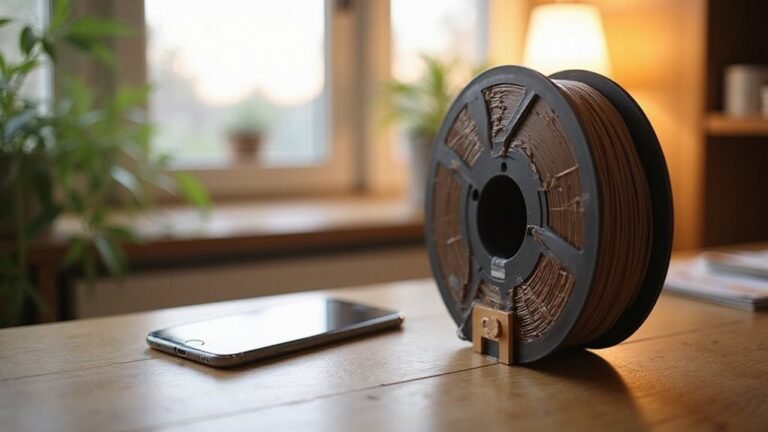
To use a filament dryer effectively, follow these key steps. First, ensure your drying equipment is compatible with your filament type. For PLA filament, set the dryer to 50°C, which is ideal for moisture removal without softening the filament. Avoid exceeding this temperature to prevent deformation or weakening. Place the filament spool evenly on the rollers, making sure it can rotate freely without tangling. Use the control panel to set the drying duration, typically between 2 and 4 hours, but extend up to 6 hours if you are dealing with high humidity conditions.
Before starting, verify that all vents are clear and the fan is functioning properly to maintain proper airflow. Once the cycle completes, turn off the unit, carefully remove the filament, and transfer it to airtight containers with desiccants. Proper storage after drying keeps the filament moisture-free and ready for printing, ensuring better print quality and fewer print failures. For optimal results, selecting a top dye sublimation printer with suitable features can help protect your filament from humidity issues in the future. Additionally, understanding the importance of filament drying can help you choose the right equipment and settings for your needs. Knowing how to properly dry filament can also extend the lifespan of your filament and improve overall print performance.
What’s the Best Way to Store Dried PLA?
Storing dried PLA properly means keeping it in airtight containers to prevent moisture absorption. Use sealed plastic bins with gasketed lids or vacuum-seal bags for the best moisture barrier. Adding silica gel packets—one to two per spool or container—helps absorb residual humidity. Regularly check color-indicator desiccants to monitor saturation, and refresh or re-dry the silica gel as needed to maintain effectiveness. Keep your storage environment cool and dry, ideally around 20 to 25 degrees Celsius (68 to 77 degrees Fahrenheit), with relative humidity below 20 percent. Label each container with the drying date to track how long the filament has been stored. Handle filament promptly when transferring it to storage to minimize moisture exposure. Proper storage techniques include avoiding exposure to sunlight and temperature fluctuations, which can compromise the desiccant’s performance and filament quality. Monitoring environmental factors and following best practices can extend the lifespan of dried filament, ensuring your prints remain high quality. Additionally, using moisture-resistant storage options can help further protect your filament from humidity and environmental damage. Ensuring that your storage environment is free from humidity fluctuations is crucial to maintaining filament quality over time. Organized storage combined with regular monitoring ensures your filament stays dry and retains optimal print quality.
Troubleshooting Common PLA Drying Problems
Drying PLA filament improperly can cause several issues that affect your prints. Overheating the filament or leaving it in a dry oven for too long can make the PLA brittle, increasing the risk of feed failures or fractures during printing. Excessive heat may also lead to spool deformation and color variations, which impact the filament’s appearance and consistency. Proper drying methods can help prevent these problems and ensure optimal print quality. Insufficient drying, on the other hand, leaves internal moisture trapped within the spool, resulting in poor print adhesion, stringing, and bubbling. Uneven drying caused by poor airflow or imprecise temperature control can leave some moisture inside the filament, degrading print quality. To avoid these problems, carefully monitor the drying temperature, extend drying times for filament exposed to moisture, and ensure adequate airflow. Proper drying enhances print adhesion and preserves consistent color, leading to more reliable and higher-quality prints. Additionally, understanding how moisture absorption impacts filament can help you develop more effective drying strategies. Being aware of environmental conditions such as humidity levels can further improve your drying results and help maintain filament quality over time.