Have you ever wondered why your 3D prints come out just right or disappoint even when using the same filament? It often comes down to temperature. Finding the perfect PLA filament temperature, usually between 195°C and 230°C, can feel a bit like balancing a seesaw—too hot, and you risk stringing or warping; too cool, and your layers won’t stick properly. Setting your printer at the right point, typically around 210–220°C, can make all the difference, and when color-changing filaments are involved, maintaining a consistent heat near their activation point (like 31°C to 45°C) becomes just as essential. So, how do you identify the ideal temperature for your project? That’s what we’re about to discover.
Color Changing PLA Filament, Black to White, 1KG
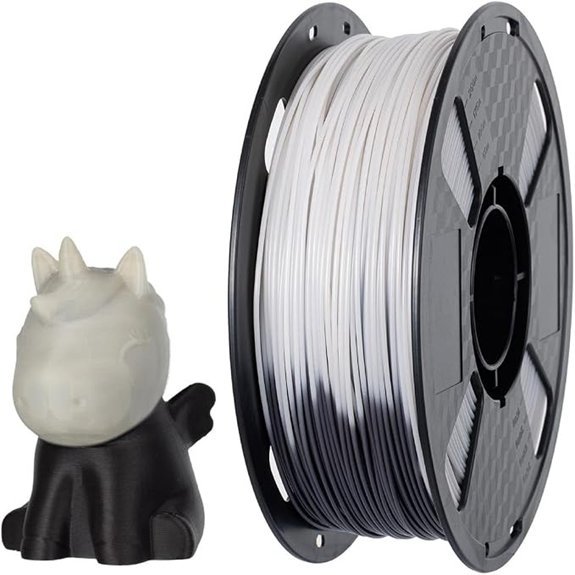
If you’re looking to add a touch of magic to your 3D printing projects, the Color Changing PLA Filament from CC3D could be exactly what you need. This filament is perfect for creating eye-catching models, especially because it shifts from black to white when temperatures hit around 31°C. Imagine a sculpture that reveals a hidden layer when warmed—pretty cool! You get 1 kilogram of filament with a diameter of 1.75mm, compatible with most FDM printers. To get the best results, print at 195–230°C with speeds from 30–90 mm/s. Just keep that heated bed between 0°C and 65°C.
Zi-Rui Tri-Color PLA 3D Printer Filament (1kg)
https://m.media-amazon.com/images/I/71+IlANPFsL._SX522_.jpg
With its temperature-activated tri-color shifting, Zi-Rui Tri-Color PLA filament is perfect for creating eye-catching models that change color with heat. Its vibrant changes—Pine Green below 31°C, Light Orange from 31°C to 45°C, and bright Yellow above 45°C—make your prints pop visually. For best results, keep your nozzle temperature between 190°C and 220°C, and hot bed at 40°C to 60°C. Confirm the filament stays dry because moisture causes layer cracks. Plus, with precise diameter control (+/-0.02mm), it feeds smoothly into most printers. Use it for projects where a colorful, temperature-sensitive touch adds real flair!
Color Change PLA Filament Purple to Pink, 1.75mm, 1kg
https://m.media-amazon.com/images/I/61ARDEGBUXL._AC_SX679_.jpg
Looking to add a fun twist to your 3D prints? The Color Change PLA Filament from Purple to Pink is perfect for that. With a 1.75mm diameter and 1kg weight, it makes vibrant, eye-catching projects possible. This filament is temperature-sensitive, shifting color from purple-blue below 31°C to pink above it, creating dynamic effects as your print cools or heats. It’s compatible with most FDM 3D printers, so no worries about hardware limitations. Whether you’re making decorative pieces or scientific models, this filament is reliable, durable, and easy to use. Plus, it supports your creative experiments with a 1-year warranty, ensuring peace of mind!
Color Changing PLA Filament 1kg for 3D Printing
https://m.media-amazon.com/images/I/61nsDTjxKFL._AC_SX679_.jpg
Color changing PLA filament 1kg is perfect if you want a fun, eye-catching project that reacts to temperature changes. With a vibrant green at below 31ºC, it transforms into a bright yellow when warmed, creating eye-popping effects. Compatible with nearly all FDM 3D printers and suitable for 3D pens, it’s easy to incorporate into your existing setup. Plus, you get high-quality PLA made by Hangzhou Zhuopu. The filament measures 1.75 mm in diameter, ensuring precise printing, and reacts reliably to heat —ideal for visual indicators or dynamic art pieces. And with a 1-year warranty, you’re covered for peace of mind as you craft!
Color Changing PLA Filament 1.75mm 1KG
https://m.media-amazon.com/images/I/615ufyz+0RL._AC_SX679_.jpg
Ever wondered how to add a touch of magic to your 3D prints? Color Changing PLA Filament 1.75mm 1KG is your secret weapon. This filament responds to temperature shifts, changing from purple or red to sky blue above 31°C. With a diameter of 1.75mm and packaged in a generous 1kg spool, it’s perfect for creating dynamic, eye-catching models. Use printing temps between 195°C and 230°C, and keep the heated bed between 0°C and 65°C for best results. Thanks to its precise ±0.05mm diameter and vibrant color options, you can craft projects that transform with heat, making your designs truly magical!
AMOLEN 3D Printing Filament, Color Changing PLA 1KG
https://m.media-amazon.com/images/I/714hS0bAtuL._AC_SX679_.jpg
If you’re after a filament that adds a fun, interactive twist to your 3D prints, AMOLEN’s Color Changing PLA 1KG could be just what you need. This filament responds to heat, shifting from black to red to yellow, creating cool effects during printing. It’s compatible with most FDM printers and offers a tight dimensional accuracy of +/- 0.02mm, which means smoother prints. Just remember, the color change is temperature-dependent—below 30°C it’s green, over 30°C it’s browning, and past 45°C, it turns yellow. Long sun exposure might fade the colors, so handle it carefully. It melts smoothly, prevents clogging, and is perfect for adding a playful, dynamic touch!
Gizmo Dorks PLA Filament 1.75mm, Color Changing Purple to Pink
https://m.media-amazon.com/images/I/71ixauAj6lL._SX522_.jpg
Looking for a fun twist in your 3D printing projects? Gizmo Dorks’ Color Changing Purple to Pink filament is perfect if you want to add a bit of magic. This 1.75mm PLA filament changes color from purple at room temp to pink when heated above 88°F. It’s ideal for printing objects with a surprise element — think glowing flowers or mood lamps. The filament measures within ±0.03mm accuracy, ensuring smooth feeds, and works best with nozzles between 190°C and 225°C. Keep it vacuum sealed, and enjoy easy handling on the spool. Just remember, temperature is your secret weapon for creating fun, color-shifting effects!
Factors to Consider When Choosing the Temperature for PLA Filament
When choosing the right temperature for your PLA filament, you’ll want to think about a few key factors. Your printer’s compatibility, the specific type of PLA you’re using, and the ambient environment can all influence the ideal settings—so it’s worth paying attention to these details. And don’t forget, layer adhesion hinges on getting the temperature just right, so your prints come out smooth and strong!
Optimal Printing Temperature
Choosing the right temperature for your PLA filament can feel like walking a tightrope—too hot, and you risk stringing or warping; too cold, and the layers won’t stick together properly. The sweet spot is usually between 195°C and 230°C, but you’ll want to fine-tune within this range based on your filament’s formulation. When you set the right temperature, you’ll get smooth, well-bonded layers that look great and are durable. If the temperature is too high, you might notice stringing or oozing; too low, and the print can be weak or rough. Keep in mind that some PLA filaments are temperature-sensitive and can change color around 31°C to 45°C, adding another layer of complexity. Small adjustments can make all the difference!
Filament Type Variations
Different types of PLA filament aren’t all cut from the same cloth — or, more accurately, the same temperature. Each formulation can have a unique ideal printing range, usually between 190°C and 230°C. For instance, specialty PLA like color-changing variants may require specific temperature tweaks—hotter or cooler—to work their magic correctly. Filament brands also differ in melting points and how well they stick to the print bed, which influences your settings.
Some filaments include:
- Standard PLA, best around 200°C
- Color-changing PLA, usually between 210°C and 220°C
- Tri-color or specialty variants that may need adjustments
Keep your filament’s guidelines handy, and be ready to make small temperature tweaks for perfect results!
Printer Compatibility Requirements
Ever wonder if your 3D printer is up to snuff for peak PLA printing? It’s vital to check if your machine can reach the right temperatures. First, confirm your nozzle supports the 195°C to 230°C range — hotter than you might think! And don’t forget about the heated bed; it should reach up to 65°C to help with filament adhesion and reduce warping.
Next, verify your extruder and hotend can maintain consistent temperatures—any fluctuation can cause stringing or uneven layers. Also, make sure that your firmware can precisely control and regulate temps in real-time. And finally, make certain your temperature sensors are accurate because stable readings lead to perfect prints. If all these boxes are checked, your printer is ready to handle PLA like a pro!
Ambient Environment Factors
Have you ever noticed that your filament seems to change color a little differently depending on where you’re printing? That’s because ambient environment factors play a big role in your filament’s behavior. Warmer surroundings can make your filament change color faster since higher temperatures trigger the shift more easily. On the flip side, cooler rooms slow down the process, delaying the color change. Fluctuations in room temperature can also interfere with your print’s adhesion and flexibility, resulting in inconsistent quality. Plus, humidity is sneaky—moisture absorbed by the filament may cause uneven heating and unpredictable color shifts. To get the best results, aim to keep your printing environment stable, with consistent temperature and humidity levels. This helps certify your filament’s color transformation remains predictable and precise.
Layer Adhesion Importance
Ensuring good layer adhesion is one of the most important aspects of producing strong, high-quality 3D prints with PLA filament. When your layers stick together well, your print becomes more durable and less prone to splitting or delaminating. Proper temperature control is key here. Printing too cold results in layers that don’t bond properly, making your print brittle. On the flip side, too high a temperature can cause stringing and uneven offsets, which also damage adhesion. It’s important to keep a consistent temperature to guarantee uniform layer bonding. And remember, adjusting your temperature based on your filament brand and environmental conditions can give your layers that perfect little hug, boosting overall strength and finish. Keep it balanced!
Bed Temperature Settings
Getting your bed temperature just right can make or break your PLA prints. Keep it between 0°C and 65°C, with around 50°C usually hitting the sweet spot for good adhesion without softening the filament too much. A proper bed temp helps prevent warping—think of it as giving your print a cozy, stable environment. Setting it too high—above 60°C—might prevent warping but can cause adhesion issues or make the soft PLA stick too much and mess up your print. Adjustments may be needed based on your filament’s formulation and your print setup. Consistency is key here. Keep the bed at the same temperature throughout, and you’ll see better layer bonding and a smoother surface. Remember, your goal is stability, not a kiln!
Color Change Trigger Points
When it comes to achieving that stunning color change effect in your PLA prints, the key factor is hitting the right temperature trigger point. These trigger points usually sit around specific temperatures like 31°C or 45°C, depending on the filament’s formulation. The trigger point remains pretty consistent, typically within a margin of plus or minus 1°C, so your color change will be reliable if you keep things precise. Keep in mind, factors like fill density or ambient temperature can influence how quickly and clearly the colors shift — making a noticeable difference. To get predictable results, match your printing temperature to the filament’s specified trigger point. This way, you’ll access smooth, consistent color transitions and stunning visual effects in your finished pieces.
Material Warping Risks
Warping in PLA filament is one of those sneaky issues that’s easy to overlook but can really mess up your print if you’re not careful. When your print temperature is too high, the filament shrinks unevenly as it cools, pulling away from the bed and warping. On the flip side, too low a temperature means poor layer bonding, which can also cause warping or cracks. The sweet spot is usually around 195°C to 230°C — staying within this range helps guarantee even melting and good adhesion. Using a heated bed set between 0°C and 65°C further reduces warping by holding the first layer in place and promoting even cooling. And keep in mind, rapid cooling can introduce internal stress, so controlling your cooling fans is key!