Did you know that the right 3D printer can drastically cut your prototyping time while boosting precision? Many overlook how advancements in quick heating, multi-material support, and automated calibration make a real difference. The top machines combine speed, accuracy, and user-friendliness, letting you turn ideas into tangible models faster than ever. If you’re serious about streamlining your process, choosing wisely will save you frustration—and maybe even a few sleepless nights. Want to know which models stand out?
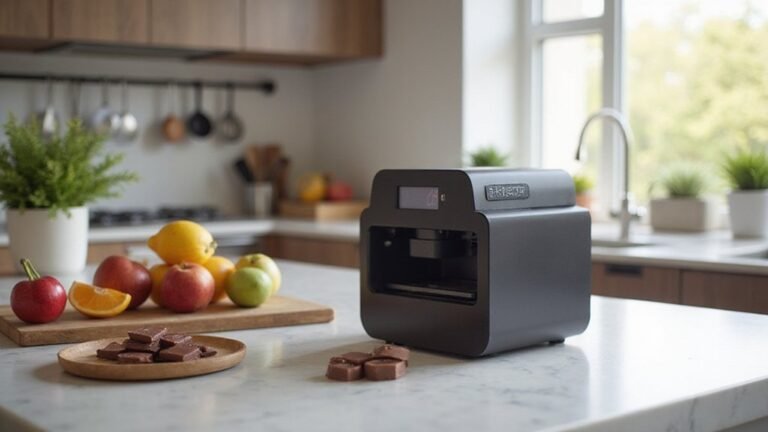
| FLASHFORGE AD5M 3D Printer with Auto Calibration |  | High-Speed Precision | Build Volume: 220x220x220mm | Nozzle Options: 0.25/0.4/0.6/0.8 mm | Auto-Leveling: Yes (automatic leveling function) | VIEW LATEST PRICE | Read Our Analysis |
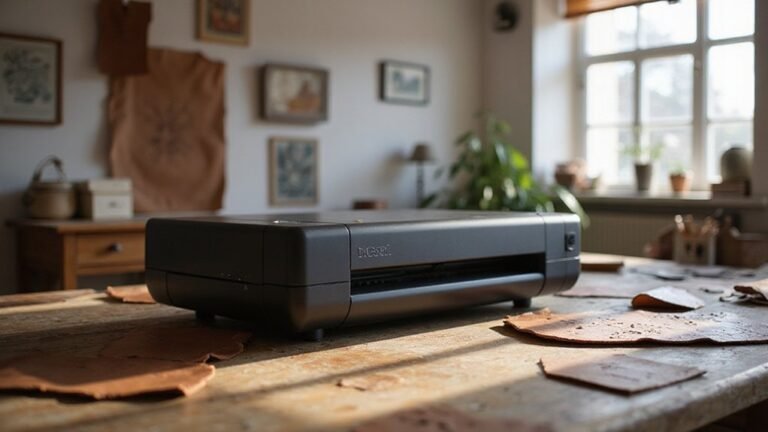
| FlashForge Adventurer 5M 3D Printer with Auto Leveling |  | User-Friendly Efficiency | Build Volume: 220x220x220mm | Nozzle Options: 0.25/0.4/0.8mm | Auto-Leveling: Yes (automatic bed leveling) | VIEW LATEST PRICE | Read Our Analysis |
| IdeaFormer 3D Conveyor Belt Printer with Infinite Z |  | Large-Scale Continuous | Build Volume: 250×250×∞mm (long format) | Nozzle Options: Multiple sizes supported (implied compatible) | Auto-Leveling: Yes (auto-calibration with Y-offset sensor) | VIEW LATEST PRICE | Read Our Analysis |
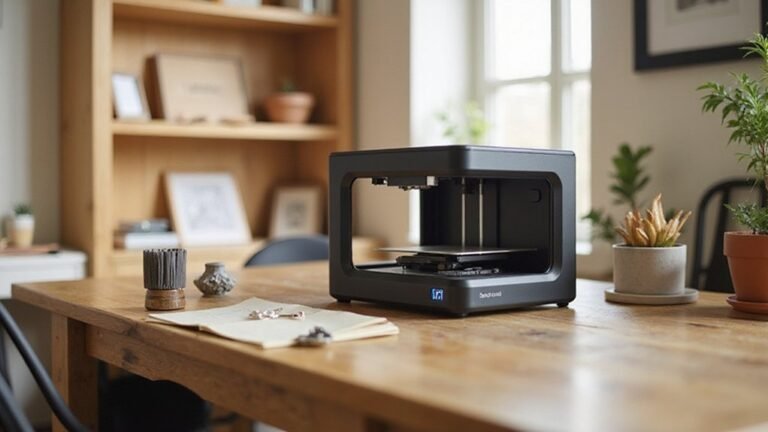
| FLASHFORGE AD5X Multi-Color 3D Printer |  | Multi-Color Power | Build Volume: 220x220x220mm | Nozzle Options: 0.25/0.4/0.6/0.8mm | Auto-Leveling: Yes (auto-leveling with quick setup) | VIEW LATEST PRICE | Read Our Analysis |
| FLASHFORGE AD5M 3D Printer with Auto Leveling |  | Automated Speed | Build Volume: 220x220x220mm | Nozzle Options: 0.25/0.4/0.6/0.8mm | Auto-Leveling: Yes (one-click auto-leveling) | VIEW LATEST PRICE | Read Our Analysis |
More Details on Our Top Picks
FLASHFORGE AD5M 3D Printer with Auto Calibration
If you’re after high-speed precision in your 3D printing, the FLASHFORGE AD5M with auto calibration fits the bill perfectly. This machine is designed to make your life easier, whether you’re a beginner or a pro. Its fully automatic leveling system takes just three seconds, removing the hassle of manual calibration. Swapping nozzles (0.25, 0.4, 0.6, or 0.8 mm) is tool-free and quick, so you can experiment without fuss. The double-sided PEI steel build plate makes model removal simple, especially for PETG filament. With high speeds of up to 600mm/sec, you get rapid, reliable results, every time!
- Build Volume:220x220x220mm
- Nozzle Options:0.25/0.4/0.6/0.8 mm
- Auto-Leveling:Yes (automatic leveling function)
- Speed Capability:600mm/s
- Filament Compatibility:PLA, PETG, TPU, reinforced filaments
- Connectivity/Remote Monitoring:Flash Maker APP, network monitoring
- Additional Feature:Double-sided PEI steel plate
- Additional Feature:All-metal CoreXY structure
- Additional Feature:Remote device management via Flash Maker App
FlashForge Adventurer 5M 3D Printer with Auto Leveling
The FlashForge Adventurer 5M 3D Printer is built for user-friendly efficiency, making it a top pick for rapid prototyping. Its fully automatic bed leveling means you won’t spend time fussing with manual adjustments—just push a button. The CoreXY all-metal structure guarantees durability and precise movements, supporting print volumes of 220x220x220mm. With a 280°C direct extruder and detachable nozzle, you can print a wide range of materials quickly and easily. Plus, its ultra-fast speed—600mm/s max travel—means you get prototypes faster. Features like remote monitoring and multiple nozzle sizes support versatile projects and seamless workflow.
- Build Volume:220x220x220mm
- Nozzle Options:0.25/0.4/0.8mm
- Auto-Leveling:Yes (automatic bed leveling)
- Speed Capability:600mm/s
- Filament Compatibility:Multiple materials, high-temp support
- Connectivity/Remote Monitoring:Flash Maker APP, remote control
- Additional Feature:Vibration compensation system
- Additional Feature:Quick 35-second warm-up
- Additional Feature:Dual-fan nozzles for print quality
IdeaFormer 3D Conveyor Belt Printer with Infinite Z
Looking for a 3D printer that can handle large-scale, continuous projects? The IdeaFormer IR3 V2 might be just what you need. It features a massive 250×250×∞mm build volume, thanks to its infinite Z-axis, created by a durable rolling conveyor belt. This means you can produce long models or run big batches without stopping to reset the Z height. Its upgraded metal belt supports a variety of filaments—PLA, ABS, TPU, and more—ensuring great adhesion and minimal warping. With auto-leveling at the push of a button and a speed of up to 400mm/s, you’ll enjoy smooth, precise, and hassle-free printing, perfect for intricate prototypes or big creative projects.
- Build Volume:250×250×∞mm (long format)
- Nozzle Options:Multiple sizes supported (implied compatible)
- Auto-Leveling:Yes (auto-calibration with Y-offset sensor)
- Speed Capability:400mm/s
- Filament Compatibility:PLA, PETG, ABS, TPU, ASA, PP
- Connectivity/Remote Monitoring:N/A (not specified, likely manual)
- Additional Feature:Infinite Z-axis design
- Additional Feature:Metal conveyor belt with PEI coating
- Additional Feature:Klipper firmware for high performance
FLASHFORGE AD5X Multi-Color 3D Printer
If you need a 3D printer that excels at multi-color power, the FLASHFORGE AD5X is a game-changer for rapid prototyping. It can print up to four colors at once, making your models vibrant and full of life. Its ultra-fast speed of 600mm/s is perfect for batch work or rushing through deadlines. The 220x220x220mm build volume fits a variety of projects, from tiny figurines to sturdy prototypes. Plus, features like 1-click auto leveling, automatic filament feeding, and remote control via the Flash Maker app make setup and operation smoother. This machine combines speed, versatility, and ease of use to help bring your ideas to life faster.
- Build Volume:220x220x220mm
- Nozzle Options:0.25/0.4/0.6/0.8mm
- Auto-Leveling:Yes (auto-leveling with quick setup)
- Speed Capability:600mm/s
- Filament Compatibility:Multiple materials, direct drive extruder
- Connectivity/Remote Monitoring:Flash Maker APP, remote monitoring
- Additional Feature:Multi-color support (up to 4 colors)
- Additional Feature:300°C direct drive extruder
- Additional Feature:Automatic filament feeding and retraction
FLASHFORGE AD5M 3D Printer with Auto Leveling
Ever wish for a 3D printer that moves at the pace of your ideas? The FLASHFORGE AD5M with auto leveling makes that happen. You get a fully automatic one-click leveling system, which means no manual Z-axis calibration—saving time and hassle. Its dual-sided PEI platforms make print removal easy and support versatile materials like PLA, PETG, TPU, and reinforced filaments. Speeds reach up to 600mm per second, with rapid acceleration and vibration compensation for sharp, blur-free results. Plus, its quick warm-up of 35 seconds guarantees you’re printing in no time. Whether you’re prototyping or DIYing, the AD5M keeps pace with your creativity.
- Build Volume:220x220x220mm
- Nozzle Options:0.25/0.4/0.6/0.8mm
- Auto-Leveling:Yes (one-click auto-leveling)
- Speed Capability:600mm/s
- Filament Compatibility:PLA, PETG, TPU, reinforced filaments
- Connectivity/Remote Monitoring:Flash Maker APP, remote monitoring
- Additional Feature:High-flow 32mm³/s nozzle
- Additional Feature:Rapid 3-second nozzle swaps
- Additional Feature:Laser-like print surface finish
Factors to Consider When Choosing a 3D Printer for Rapid Prototyping
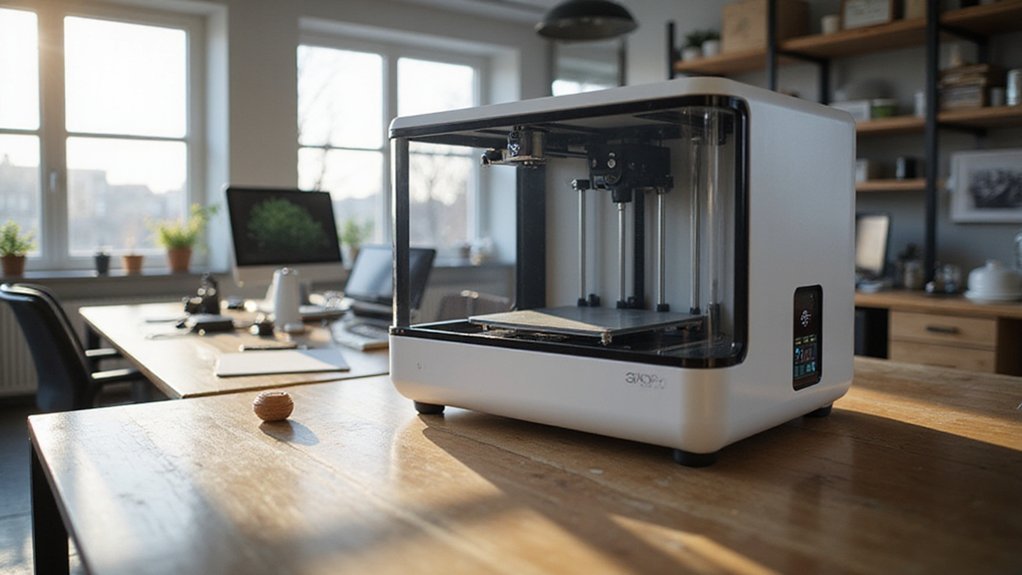
Choosing the right 3D printer for rapid prototyping means looking at several key factors. You’ll want to *think about* speed, material options, how easy it is to set up and calibrate, the size of your projects, and how much maintenance it needs. Keep these points in mind to find a machine that matches your workflow and helps you bring ideas to life quickly and reliably.
Printing Speed Capabilities
Speed is a key player when it comes to rapid prototyping, and the right 3D printer can make or break your workflow. If you need quick results, look for printers with high printing speeds—think around 600mm/s. Faster acceleration, like 20,000mm/s², means less waiting and smoother starts even at top speeds. The best printers let you switch between high-speed and high-precision modes, giving you flexibility for different project needs. Advanced extruder systems support high flow rates, so you won’t sacrifice output quality at faster speeds. The trick is consistent movement accuracy—without it, your prototypes will suffer. To wrap it up, focus on:
- Speed ratings in mm/s
- Acceleration figures
- Mode switching options
- Extruder performance
- Movement precision
Material Compatibility Options
Have you ever wondered if your 3D printer can handle more than just basic PLA? It’s a smart question because material compatibility really opens up your options. Look for a printer that supports a wide range of materials like PETG, ABS, TPU, and flexible filaments — perfect for different prototyping needs. Check if the extruder can reach around 300°C, especially for ABS and specialty filaments. Reinforced options like PLA-CF and PETG-CF add strength and durability — critical for functional prototypes. Also, consider nozzle sizes—something like 0.4mm is standard, but larger or smaller gauges let you fine-tune detail or speed. Broad material compatibility lets your creativity run wild, and that’s what rapid prototyping’s all about!
Calibration & Ease of Use
Getting your 3D printer set up correctly is half the battle when it comes to rapid prototyping, and that’s where calibration and user-friendliness come into play. If your printer has automatic bed leveling, like one-click auto-calibration, it dramatically cuts down setup time and *guarantees* a perfect first layer—crucial for accurate models. Features like rapid nozzle swaps and tool-free calibration make it easier to maintain and adjust on the fly. High-precision calibration mechanisms help keep dimensions spot-on and repeatable. User-friendly interfaces and remote monitoring simplify operation, even if you’re new to 3D printing. And when it’s easy to calibrate the different materials you’re working with, you prevent problems like warping or layer misalignment, keeping your rapid prototypes accurate and stress-free.
Print Volume Adequacy
When choosing a 3D printer for rapid prototyping, one of the most critical factors to take into account is the print volume—basically, how big your projects can get. You’ll want to guarantee the build volume can comfortably handle common prototypes, ideally at least 220x220x220mm for versatility. Larger sizes mean more complex, multi-part assemblies in a single print session, saving time and effort. Consider printers with features like automatic bed leveling and adjustable surfaces to maximize your effective volume. Keep in mind, bigger print volumes can mean longer print times, so balance your size needs against speed requirements. Also, modular printers or conveyor belt setups with infinite Z-axis can stretch your capacity even further, producing longer or larger prototypes without constant manual intervention.
Maintenance & Reliability
Maintaining a 3D printer for rapid prototyping isn’t just about hitting print and hoping for the best; it’s an ongoing process that guarantees consistent, high-quality results. Automated calibration features like auto-leveling save you from manual tweaks and keep your prints precise, especially for quick turnaround prototypes. Regular tasks such as nozzle cleaning and belt tension checks are essential to prevent print failures and maintain smooth operation. Look for models with durable all-metal frames and reinforced print beds—these hold up under fast, repeated use and improve stability. Features like vibration compensation and high-quality extrusion systems reduce errors and produce cleaner results. Plus, choosing a printer with good manufacturer support and warranty coverage helps you solve potential issues quickly, minimizing downtime and keeping your rapid prototyping on track!
Multi-Color Support
Adding multi-color support to your 3D printer can be a game-changer for rapid prototyping, especially when you want your models to look more realistic or to clearly distinguish different parts. These printers often feature multiple extruders or advanced mixing systems that let you switch or blend colors during a single print. This can save you a ton of time—no more painting or post-processing to get that perfect look. Plus, multi-color support makes it easier to create prototypes with color coding or intricate details that highlight different features. Be aware that these systems can be a bit finicky—they might need extra setup or calibration, and maintenance can be more involved. But if visual complexity is top priority, multi-color capability is a smart investment.
Software & Monitoring Features
Ever wonder how some 3D printers seem to run smoothly like well-oiled machines while others give you headaches? The secret often lies in their software and monitoring features. Good compatibility and an easy-to-use interface make design prep and slicing quicker, boosting your overall speed. Advanced monitoring tools, like remote control, real-time print updates, and alerts for issues, help you stay on top of your job without constantly staring at the machine. Integration with mobile apps lets you manage and troubleshoot from anywhere—pretty handy. Features like batch printing, multi-printer network monitoring, and safeguards like print resume after power loss or auto-calibration cut down errors and keep quality consistent. These tools turn headaches into smooth, efficient prototyping sessions.
Price & Support Value
When shopping for a 3D printer for rapid prototyping, price and support value should be top of mind—after all, a machine that costs a fortune but leaves you stranded when something goes wrong isn’t much good. You want a printer that balances features with affordability, giving you good overall value. Check if the manufacturer offers solid support options like warranty coverage, remote diagnostics, firmware updates, and quick-response customer service. Clear documentation and active community forums are gold for troubleshooting fast. Opt for brands known for reliable support, because ongoing assistance and upgrades matter as your projects grow more complex. And don’t forget: accessible help and robust support can turn a frustrating setback into a quick fix—and save you time, money, and headaches.