Did you know that industries using advanced 3D printers report up to a 50% increase in productivity? That’s because cutting-edge models like the Creality K2 Plus, Longer LK5 Pro, and Prusa XL can handle complex, large-scale projects faster and more accurately than ever before. These printers support multi-material setups, feature quick warm-ups, and incorporate automation that reduces downtime. If you’re serious about pushing your manufacturing limits and boosting efficiency, understanding which models lead the pack is essential—you’ll want to see what makes these five stand out.
| Creality K2 Plus 3D Printer with Auto-Leveling |  | Multi-Color Masterpiece | Build Volume: 350×350×350 mm | Multi-Material Support: Yes, supports multi-color via CFS + RFID | Auto-Leveling: Yes, auto-leveling with auto-adjustment | VIEW LATEST PRICE | Read Our Analysis |
| Longer LK5 Pro 3D Printer with Resume Function |  | User-Friendly Precision | Build Volume: 11.8×11.8×15.7 inches (300×300×400 mm) | Multi-Material Support: Yes, multi-material compatible with filament sensors | Auto-Leveling: Yes, automatic bed leveling and calibration | VIEW LATEST PRICE | Read Our Analysis |
| Original Prusa XL 3D Printer with Dual Tool System | 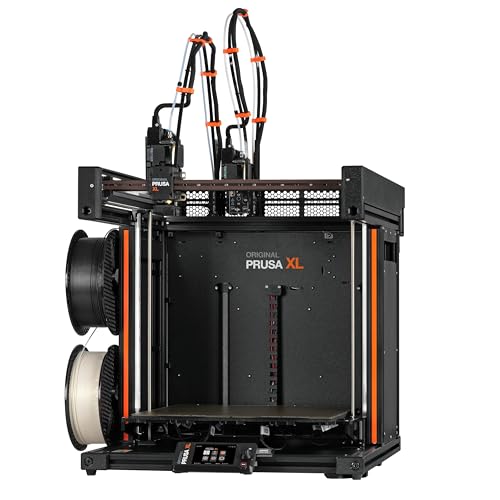 | Industrial Powerhouse | Build Volume: 14.17×14.17×14.17 inches (approx. 360×360×360 mm) | Multi-Material Support: Yes, dual-tool system for multi-material printing | Auto-Leveling: Yes, intelligent heated bed with easy setup | VIEW LATEST PRICE | Read Our Analysis |
| Bambu Lab P1S 3D Printer with Multi-Material Support |  | High-Speed Versatility | Build Volume: 18.72×20.67×18.72 inches (approximately 476×525×476 mm) | Multi-Material Support: Yes, supports up to 16 colors with AMS | Auto-Leveling: Yes, automatic bed leveling | VIEW LATEST PRICE | Read Our Analysis |
| FLASHFORGE Adventurer 5M 3D Printer with Auto Leveling |  | Rapid Prototyping Excellence | Build Volume: 220×220×220 mm | Multi-Material Support: Yes, multi-material support with auto leveling | Auto-Leveling: Yes, auto bed leveling | VIEW LATEST PRICE | Read Our Analysis |
More Details on Our Top Picks
Creality K2 Plus 3D Printer with Auto-Leveling
If you’re after a multi-color masterpiece that’s as smart as it is powerful, the Creality K2 Plus with auto-leveling is a top choice for industry pros. Imagine this: a large build area of 350 by 350 by 350mm, perfect for big projects or batch runs. With advanced CFS technology, it mixes up to 16 colors seamlessly, saving you the time and hassle of post-processing. Plus, its intelligent sensors automatically load filaments, monitor status, and even read RFID tags for quick color swaps. The dual AI cameras keep an eye on your print, catching issues early and ensuring precision every time. It’s an all-in-one workhorse that simplifies complex multi-color printing.
- Build Volume:350×350×350 mm
- Multi-Material Support:Yes, supports multi-color via CFS + RFID
- Auto-Leveling:Yes, auto-leveling with auto-adjustment
- Printing Speed:Up to 600mm/s
- Connectivity / Smart Features:Sensors, cameras, RFID, app control
- User Interface / Setup:User-friendly interface, high automation
- Additional Feature:Multi-color CFS system
- Additional Feature:Advanced AI camera monitoring
- Additional Feature:Aerospace-grade aluminum frame
Longer LK5 Pro 3D Printer with Resume Function
The Longer LK5 Pro 3D Printer stands out for its user-friendly precision, making it a top choice if you need reliable performance. Built with a sturdy triangular frame and reinforced inclined rods, it offers great stability, reducing resonance errors during high-speed printing. It supports large build sizes up to 11.8 x 11.8 x 15.7 inches and works with a variety of materials, sparking creativity. Key perks include fast printing at 180mm/s, with 0.1mm precision thanks to automatic calibration. Features like filament sensors, power detection, and the ability to resume after interruptions save you time and material. Assembly is simple, and the community support is solid.
- Build Volume:11.8×11.8×15.7 inches (300×300×400 mm)
- Multi-Material Support:Yes, multi-material compatible with filament sensors
- Auto-Leveling:Yes, automatic bed leveling and calibration
- Printing Speed:Up to 180mm/s
- Connectivity / Smart Features:Automated, pre-assembled, community support
- User Interface / Setup:Pre-assembled, easy setup, beginner-friendly
- Additional Feature:Pre-assembled at 90%
- Additional Feature:Silicon carbide lattice glass platform
- Additional Feature:Ultra-quiet TMC2209 drivers
Original Prusa XL 3D Printer with Dual Tool System
Looking for an industrial powerhouse that can handle complex, large-scale projects with ease? The Original Prusa XL 3D Printer with Dual Tool System might just be what you need. It boasts a massive build volume of 14.17 inches in all directions, perfect for big prototypes and multi-material parts. Its dual-tool system lets you switch between different filaments seamlessly, reducing downtime. The CoreXY motion system provides high precision and speed, while features like a segmented heated bed minimize warping. Plus, with PrusaSlicer and Printables.com, your workflow stays smooth. And don’t worry—setting it up is straightforward, with protection-packed parts for quick assembly.
- Build Volume:14.17×14.17×14.17 inches (approx. 360×360×360 mm)
- Multi-Material Support:Yes, dual-tool system for multi-material printing
- Auto-Leveling:Yes, intelligent heated bed with easy setup
- Printing Speed:Not specified (industrial high performance implied)
- Connectivity / Smart Features:Ideal for advanced workflows, ecosystem integrated
- User Interface / Setup:Safe, quick setup, integrated ecosystem
- Additional Feature:Dual-material multi-tool system
- Additional Feature:Segmented heated bed
- Additional Feature:Modular, quick-assemble design
Bambu Lab P1S 3D Printer with Multi-Material Support
When you need high-speed versatility in a 3D printer, the Bambu Lab P1S with multi-material support stands out for industry professionals. With a rapid print speed of up to 500mm/s and high precision, this fully enclosed FDM machine is built for large projects. It’s great for complex, colorful designs—supporting up to 16 colors or multiple materials, though you’ll need the Bambu Lab AMS system for multi-material operation. Its enclosed design and auto bed leveling help you get reliable, high-quality results with minimal fuss. Assembly takes about 15 minutes, making it a smart choice for both pros and hobbyists enthusiastic to boost productivity.
- Build Volume:18.72×20.67×18.72 inches (approximately 476×525×476 mm)
- Multi-Material Support:Yes, supports up to 16 colors with AMS
- Auto-Leveling:Yes, automatic bed leveling
- Printing Speed:Up to 500mm/s
- Connectivity / Smart Features:Enclosed design, plug-and-play, remote monitoring
- User Interface / Setup:Quick assembly, simple operation
- Additional Feature:Fully enclosed build chamber
- Additional Feature:Automatic bed leveling
- Additional Feature:Support for high-performance filaments
FLASHFORGE Adventurer 5M 3D Printer with Auto Leveling
If rapid prototyping excellence is your goal, the FLASHFORGE Adventurer 5M 3D Printer with Auto Leveling could be a top choice. This machine offers a fully automatic bed leveling system, so no more guesswork or manual adjustments—just press a button and get a perfect first layer every time. Its all-metal CoreXY structure guarantees durability and stability, even at high speeds. It can print at up to 600mm/s with a 35-second warm-up, making quick turnarounds a breeze. And with features like remote monitoring, a detachable nozzle, and a versatile high-temp extruder, you’re equipped for creative projects and production alike.
- Build Volume:220×220×220 mm
- Multi-Material Support:Yes, multi-material support with auto leveling
- Auto-Leveling:Yes, auto bed leveling
- Printing Speed:Up to 600mm/s
- Connectivity / Smart Features:Remote monitoring via app, automatic functions
- User Interface / Setup:Easy setup, quick warm-up
- Additional Feature:Rapid tool change (3-sec nozzle)
- Additional Feature:High-flow extruder (32mm³/s)
- Additional Feature:Remote monitoring via mobile app
Factors to Consider When Choosing a 3D Printer for Industry
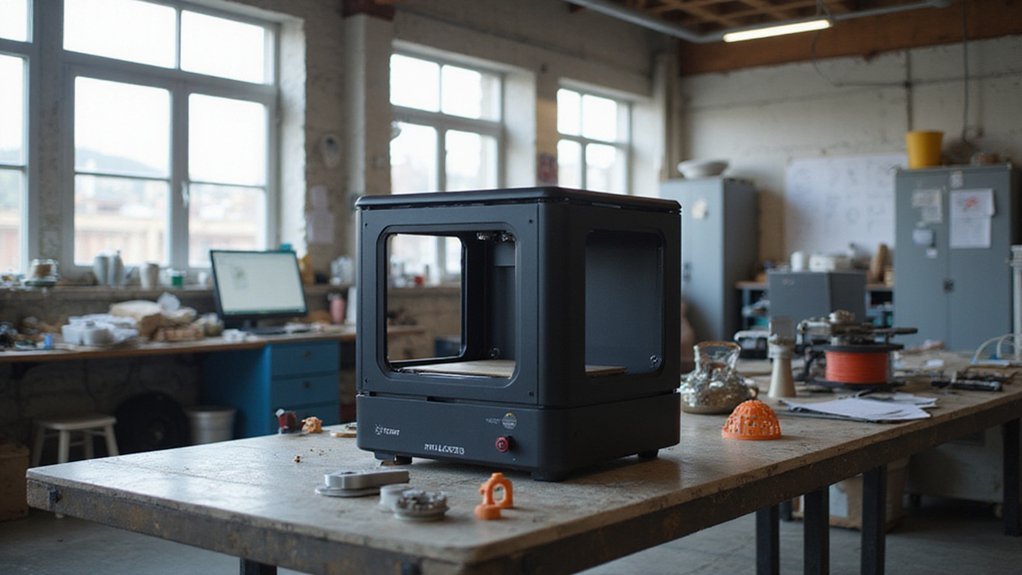
When choosing a 3D printer for industry, you’ll want to focus on key factors like printing speed, material compatibility, and build volume, since these determine how efficiently and creatively you can work. Automation features can save you time and reduce errors, but don’t forget to check for precision and accuracy to guarantee your parts meet high standards. Keep in mind that the best printer balances these points based on your specific needs, whether it’s rapid prototyping or detailed manufacturing.
Printing Speed Capabilities
Speed is a critical factor when choosing an industrial 3D printer, especially if time really is money in your line of work. Faster printing speeds mean quicker production cycles—perfect for tight deadlines or high-volume jobs. For example, a maximum travel speed of 600mm/s can cut down print times considerably for large or complex models. Plus, increased acceleration—like 30,000mm/s²—allows for rapid starts and stops, making detailed designs less time-consuming. But keep in mind, high-speed capabilities need advanced motion systems and solid frames to keep accuracy intact. Balancing speed with precision is key; rushing can lead to defects such as misaligned layers or poor adhesion. So, look for a machine that pushes limits without sacrificing quality—speed is great, but accuracy wins every time!
Material Compatibility Range
Choosing the right industrial 3D printer means considering how many different materials it can handle—think of it as expanding your creative toolkit. Compatibility with a wide variety of filaments like PLA, ABS, PETG, and TPU means you can ramp up versatility and meet different project needs. If you need parts with high strength or resistance to warping, look for a printer that supports high-temperature filaments like PPA, ASA, or PEEK. Specialty materials, such as carbon fiber or glass fiber reinforced filaments, demand a compatible extruder and heated chamber. Multi-material support or dual extrusion systems are game changers—they let you print complex, multi-colored, or multi-material prototypes effortlessly. Basically, your printer’s material range defines what you can create and how ambitious your projects can get!
Build Volume Flexibility
The size of your 3D printer’s build volume is often a game-changer for industrial projects. If it’s too small, you might be stuck splitting larger models or making multiple print runs, wasting time and money. But a bigger build volume allows you to print bigger prototypes or parts in one go, reducing assembly steps. Flexibility is key—look for printers with adjustable or expandable build areas, so your machine can grow with your project needs. Keep in mind, limited build sizes might restrict complex or large-scale projects, impacting your options. And size affects your workspace and investment—bigger usually means higher costs and more room. So, think about your current needs, future growth, and workspace constraints before choosing a machine with the right build volume flexibility.
Automation Features Availability
Automation features in 3D printers can make a huge difference when it comes to industrial workflows. They cut down on manual input, which means more time focusing on design and less on troubleshooting. With sensors and automated filament switching, you get continuous prints, so downtime is minimized during long or complex jobs. Features like RFID filament reading and auto-adjustments improve consistency because they prevent human error. Automated monitoring systems, including cameras and sensors, enable real-time troubleshooting and remote management—imagine fixing issues without stopping production. While these automation options often bump up initial costs, they pay off by saving time and reducing labor, boosting everyday efficiency. Basically, if you want to streamline your workflow and minimize hiccups, automation features are something to seriously consider.
Precision and Accuracy
When it comes to industrial 3D printing, precision and accuracy aren’t just fancy buzzwords—they’re the backbone of producing reliable, high-quality parts. You want a printer that can produce detailed layers, ideally around 0.05mm or better, to capture fine features. Consistent filament feed with high-precision stepper motors and calibrated axes guarantees accuracy from start to finish. Thermal stability prevents warping on long prints, while minimal vibrations keep layers straight and true. Auto-leveling sensors help keep the print bed perfectly flat, directly affecting dimensional accuracy. And advanced motion control tech like Input Shaper and Pressure Advance can reduce artifacts and layer shifts, turning complex shapes into clean, precise results. After all, in the industry, precision isn’t just nice to have—it’s everything!
Ease of Maintenance
Ever wonder what makes a 3D printer truly user-friendly in an industrial setting? It’s all about ease of maintenance. When choosing, look for models with automatic bed leveling and self-calibration, so you don’t spend hours fiddling with settings. Easy access to nozzles, filament slots, and print beds matters — quick swaps save downtime. Features like onboard diagnostics and automated fault detection spot issues early, keeping your workflow smooth. One more thing — detailed user manuals and troubleshooting guides are lifesavers when a quick fix is needed. And if the printer has a modular design with spare parts readily available, you’ll cut repair times greatly. Keep these factors in mind, and your uptime will soar — smooth operation is worth its weight in gold!