If you’re serious about crafting perfect fishing lures, choosing the right 3D printer can make all the difference. Some models, like the ELEGOO Saturn 4 Ultra and Creality Halot-X1, excel at high-resolution details and reliable auto-leveling, making lifelike results happen smoothly. Others, like the ELEGOO Neptune 3 Pro, are user-friendly for beginners, while the Entina Tina2 offers a straightforward setup for quick batch production. But which one suits your needs best? Let’s break down what to look for and what each model delivers.
| ELEGOO Neptune 3 Pro 3D Printer with Auto Leveling | User-Friendly Precision | Build Volume: 8.85×8.85×11 inches | Auto Leveling: Yes (36-point auto bed leveling) | Print Technology: FDM (Fused Deposition Modeling) | VIEW LATEST PRICE | Read Our Analysis | |
| ELEGOO Saturn 4 Ultra 16K Resin 3D Printer |  | High-Resolution Detail | Build Volume: 8.33 × 4.66 × 8.66 inches | Auto Leveling: Yes, auto-leveling | Print Technology: LCD resin-based | VIEW LATEST PRICE | Read Our Analysis |
| Creality Halot-X1 Resin 3D Printer with Auto Leveling |  | Professional Quality | Build Volume: 211.68 × 118.37 × 200 mm | Auto Leveling: Yes, auto-leveling | Print Technology: LCD resin-based | VIEW LATEST PRICE | Read Our Analysis |
| Entina Tina2 3D Printer for Beginners and Kids |  | Beginner’s Choice | Build Volume: 100x105x100mm | Auto Leveling: Yes, automatic leveling | Print Technology: FDM (Fused Deposition Modeling) | VIEW LATEST PRICE | Read Our Analysis |
More Details on Our Top Picks
ELEGOO Neptune 3 Pro 3D Printer with Auto Leveling
If you’re after a user-friendly precision tool for creating fishing lures, the ELEGOO Neptune 3 Pro is a smart choice. It’s compact, measuring about 23 by 9 by 19 inches, so it fits comfortably on most countertops. The build volume is 8.85 by 8.85 by 11 inches, enough for detailed, custom lure designs. With pre-assembled parts, setup is quick and straightforward. This printer features an auto bed leveling system with 36 points, ensuring your first layer sticks perfectly every time. Plus, the silent stepper motors mean you get smooth, accurate prints without disturbing the neighbors — or you!
- Build Volume:8.85×8.85×11 inches
- Auto Leveling:Yes (36-point auto bed leveling)
- Print Technology:FDM (Fused Deposition Modeling)
- Display Screen:Removable touchscreen
- Connectivity:Not specified
- Ease of Use:Pre-assembled, user-friendly features
- Additional Feature:Silent stepper motors
- Additional Feature:Removable PEI flexible platform
- Additional Feature:Filament runout sensor
ELEGOO Saturn 4 Ultra 16K Resin 3D Printer
For those chasing ultra-fine details in their fishing lures, the ELEGOO Saturn 4 Ultra 16K Resin 3D Printer stands out. Its 16K high-resolution mono LCD guarantees your lures get every tiny scale and hook detail just right. With a spacious build area of roughly 8.33 by 4.66 by 8.66 inches, you can produce multiple lures at once or larger models efficiently. The quick 150mm per hour printing speeds, combined with a plug-and-play auto-leveling system and tilt release tech, make setup and layer removal worry-free. Plus, integrated AI and chamber lights are a bonus for monitoring, day or night. It’s a powerful, user-friendly choice for crafting perfect fishing lures.
- Build Volume:8.33 × 4.66 × 8.66 inches
- Auto Leveling:Yes, auto-leveling
- Print Technology:LCD resin-based
- Display Screen:3.97-inch touchscreen
- Connectivity:Compatible with software, likely Wi-Fi or USB
- Ease of Use:Plug-and-play, quick setup
- Additional Feature:High-speed 150mm/h printing
- Additional Feature:Built-in AI camera
- Additional Feature:Real-time print monitoring
Creality Halot-X1 Resin 3D Printer with Auto Leveling
The Creality Halot-X1 Resin 3D Printer delivers professional-quality detail, making it perfect if you want super precise fishing lures. Its 10.1-inch 16K mono LCD screen offers a resolution of 15120×6230 pixels, giving you ultra-fine detail. The build volume is 211.68 by 118.37 by 200 mm, so you can create multiple lures at once. Auto-leveling makes setup smoother and guarantees consistent results. Quick resin heating speeds up production, and the intelligent resin management system minimizes waste. Plus, the design includes a user-friendly touchscreen, twist-to-release build plate, and even independent light zones to cut down overexposure.
- Build Volume:211.68 × 118.37 × 200 mm
- Auto Leveling:Yes, auto-leveling
- Print Technology:LCD resin-based
- Display Screen:10.1-inch mono LCD
- Connectivity:Not specified
- Ease of Use:User-friendly interface, quick assembly
- Additional Feature:16K high-resolution LCD
- Additional Feature:Rapid resin heating
- Additional Feature:RFID resin recognition
Entina Tina2 3D Printer for Beginners and Kids
Looking for a beginner-friendly 3D printer that makes creating fishing lures easier than ever? The Entina Tina2 Basic is perfect for that. It’s lightweight and fully assembled out of the box, so setting up takes just about five minutes. Its compact size (8.3 by 8.3 by 11.4 inches) fits comfortably on a desktop or in a classroom. The sturdy, open-source design means you can personalize it to your needs, while its automatic leveling and simple controls ensure you get precise, high-quality prints every time. Plus, the magnetic build plate makes removing finished lures effortless. Whether you’re a hobbyist or teaching kids, Tina2 turns 3D printing into a fun, safe experience.
- Build Volume:100x105x100mm
- Auto Leveling:Yes, automatic leveling
- Print Technology:FDM (Fused Deposition Modeling)
- Display Screen:2.4-inch LCD
- Connectivity:MicroSD card
- Ease of Use:Fully assembled, simple setup
- Additional Feature:Fully assembled out of box
- Additional Feature:Automatic bed leveling
- Additional Feature:Magnetic removable build plate
Factors to Consider When Choosing a 3D Printer for Fishing Lures
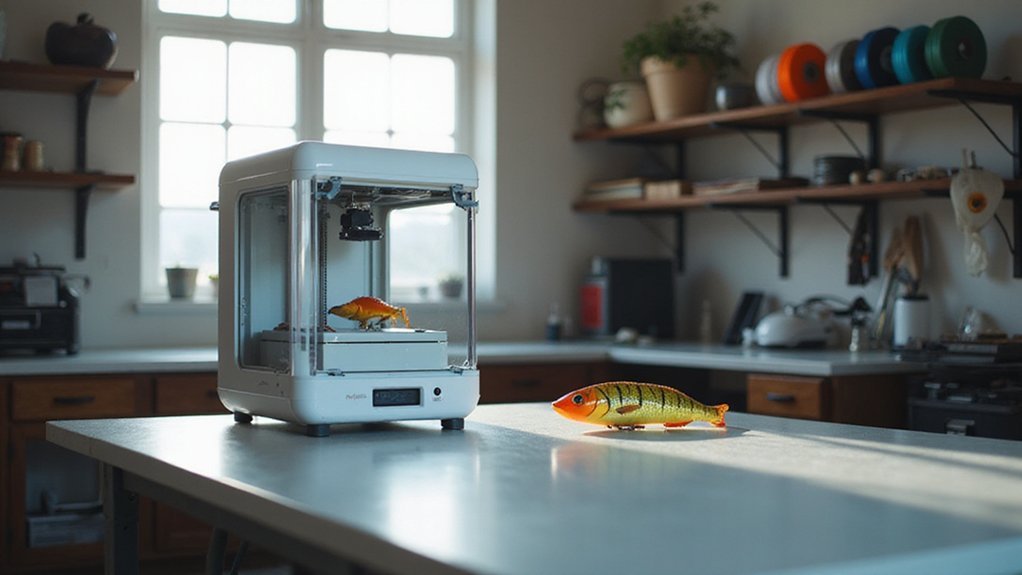
When choosing a 3D printer for fishing lures, you’ll want to think about a few key factors that can make or break your projects. Things like compatibility with different print materials, the level of detail you can achieve, and how much volume you can print at once are essential to weigh. And don’t forget about ease of use, printing speed, and how efficiently the machine can work through your designs — all of these play a big role in your success.
Print Material Compatibility
Choosing the right 3D printer for fishing lures means paying close attention to the materials it can handle. You want a machine compatible with filaments like PLA, TPU, or ABS—each offering unique benefits for lure durability and flexibility. If you plan to create elastic, bendable parts, make certain your printer supports flexible materials like TPU, which can stretch without snapping. Check filament diameter compatibility, usually 1.75mm or 2.85mm, so you don’t run into feeding issues. Also, examine the heated bed and nozzle temperature ranges to see if they can melt your chosen filaments properly—PLA needs lower temps, while ABS and TPU require higher ones. And if you’re eyeing specialized filaments for outdoor use or UV resistance, verify your printer can handle those too!
Resolution and Detail
Achieving fine detail in your fishing lures can make all the difference between a catch and a dud, so paying attention to resolution is key. Higher resolution printers produce sharper edges and smoother surfaces, which are crucial for realistic designs. For resin printers, look for a 16K mono LCD screen or higher—these can replicate tiny features like eyes, scales, and intricate patterns that attract fish. FDM printers should have a layer height of 0.05 mm or less for the best detail. Keep in mind, ultra-fine resolution might mean longer print times, but it’s worth it for those crisp, eye-catching patterns. Remember: better detail enhances the lure’s realism and effectiveness. Balancing print time and quality is essential—so don’t rush the process!
Print Volume Size
The size of the print volume is a crucial factor that directly impacts what kind of fishing lures you can produce with your 3D printer. If you’re making smaller lures, a printer with a build size of around 100x100x100mm might do the trick. But if you want more versatility—say, creating larger or multiple lures at once—you’ll want something bigger. Think about dimensions like 225x225x280mm; these give you plenty of room for bigger projects or batch printing. An adjustable or expandable print volume is even better, because your projects will evolve over time. Choosing a printer with the right size helps you avoid resizing or splitting models, saving time and effort, and making your lure-making process smoother and more efficient!
Ease of Use
When it comes to producing fishing lures with a 3D printer, ease of use can make a big difference—especially if you’re just starting out or prefer a smooth, hassle-free process. A user-friendly interface, like a touchscreen or simple controls, helps you get up and running quickly without fuss. Automatic bed leveling guarantees your prints come out right every time, saving you from tedious manual calibration. Clear setup instructions or pre-assembled components cut down the learning curve, so you’re not lost in technical jargon. Features like filament runout sensors and resume printing functions mean fewer interruptions and less troubleshooting. And a straightforward slicing software or integrated interface makes preparing your models quick and painless, freeing you up to focus on designing that perfect lure.
Speed and Efficiency
Speed and efficiency play a huge role when choosing a 3D printer for making fishing lures, especially if you want to get a lot done in less time. Faster printers with layer speeds up to 170 mm/h mean you can crank out multiple lures quickly, saving you hours. Look for models with auto-leveling and precise extrusion—these minimize material waste and cut down on reprints, which is a huge time saver. Handling different filament types, like flexible TPU, lets you switch up lure designs without hassle, speeding up production. Automated features like filament runout sensors and power-loss recovery keep your workflow smooth, even if the power flickers. And, bigger build volumes reduce the number of print sessions, making volume lure creation more efficient.
Maintenance and Durability
Maintaining a 3D printer for fishing lures isn’t just about keeping things clean; it’s about ensuring your machine stays in top shape for the long haul. A durable printer should have a sturdy frame and tough components that resist wear and tear from constant use and filament swaps. Regular maintenance is key—clean the print bed and nozzle often to prevent clogs and mechanical hiccups. High-quality parts, like tempered build plates and corrosion-resistant extruders, boost longevity in demanding environments. Plus, a good cooling system and stable temperature control are essential to prevent sensitive parts from wearing out prematurely. And when parts need replacing, it’s a huge bonus if your printer offers easy access. Simple maintenance means fewer repairs and more reliable fishing lure production!
Cost and Budget
Finding the right 3D printer for fishing lures isn’t just about picking the flashiest model; it hinges on how well it fits your budget and long-term plans. First, determine your overall budget, including the initial cost and ongoing expenses like filament or resin, since some materials can get pricey. Higher-priced models often offer better precision, larger build volumes, and extra features, which could make your lure-making easier and more detailed. But don’t forget to evaluate the cost-effectiveness of consumables — cheaper filament might save you money upfront, but could require more post-processing or adjustments. And factor in future costs like maintenance, repairs, or upgrades, so you know your total investment aligns with your fishing lure goals. Balance quality with price to ensure you’re set for the long haul!